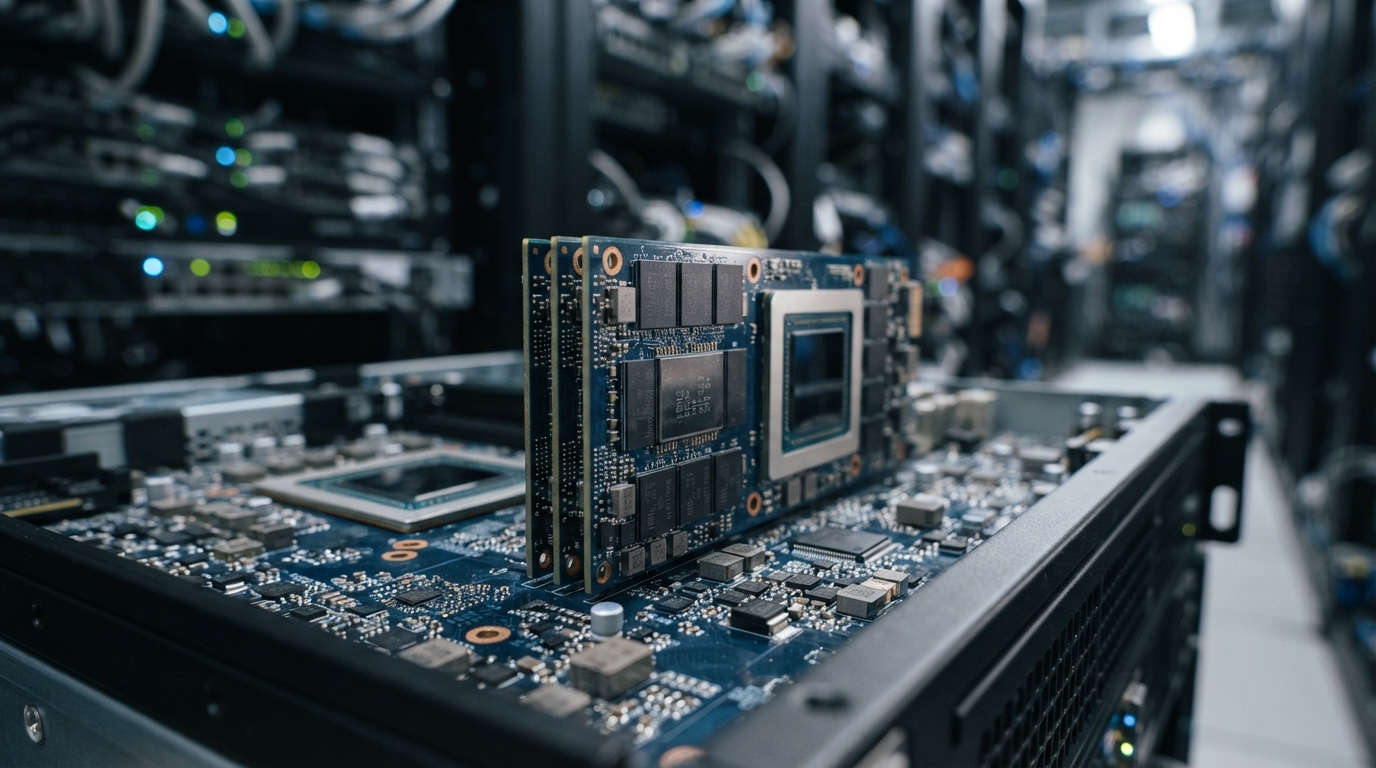
Next generation memory market projected to reach $15.63 billion by 2030, driven largely by AI workloads
High-bandwidth memory and emerging non-volatile technologies are central to overcoming data bottlenecks in computing
Growth signals a structural shift in chip design priorities, from raw processing speed to memory and data movement efficiency
The market for next generation memory technologies is projected to reach $15.63 billion by 2030, according to industry forecasts, as chipmakers race to solve a problem that has quietly become one of computing's most expensive bottlenecks: getting data to and from processors fast enough to keep pace with artificial intelligence workloads. The figure underscores a shift already underway across the semiconductor industry, where memory has moved from a supporting component to a strategic battleground.
Why Memory, Not Just Processors, Now Drives AI Performance
For decades, computing performance gains were measured mostly in processor speed. That calculus has changed. Modern AI training and inference workloads move enormous volumes of data, and when memory cannot keep pace with processing power, expensive chips sit idle waiting for data rather than computing.
This phenomenon, often described as the "memory wall," has pushed companies to invest heavily in high-bandwidth memory (HBM), which stacks memory chips vertically and connects them to processors through shorter, faster pathways. Nvidia, AMD, and other major chip designers now rely on HBM to feed their most advanced AI accelerators.
Beyond HBM, a broader category of emerging memory types is gaining commercial traction, including magnetoresistive RAM (MRAM), resistive RAM (ReRAM), and phase-change memory. Each promises some combination of speed, energy efficiency, and non-volatility that could eventually challenge the decades-old dominance of conventional DRAM and NAND flash.
AI's Memory Wall Fuels a $15.6B Chip Race
A Market Reshaped by Data Centre Demand
The forecast growth to $15.63 billion by 2030 reflects demand concentrated heavily in data centres, where operators are under pressure to run AI models faster while managing soaring electricity costs. Memory that reduces energy consumption per computation has become as commercially valuable as memory that simply moves data faster.
Hyperscale cloud providers, which operate the infrastructure behind most large AI systems, have become some of the most influential buyers in the memory supply chain. Their purchasing decisions increasingly shape which memory technologies manufacturers prioritise for mass production, a dynamic similar to shifts seen in other corners of the AI infrastructure buildout, including debates over how AI systems handle data responsibly as deployment scales.
Smartphones, automotive systems, and edge computing devices represent a secondary but meaningful growth driver. As more AI processing moves closer to where data is generated, rather than solely in centralised data centres, demand for low-power, high-performance memory is expected to spread beyond traditional computing hardware.
What the Growth Signals for Chip Supply Chains
The expansion of next generation memory also reflects a broader restructuring of semiconductor supply chains, which have faced repeated disruptions over the past several years. Concentration among a small number of manufacturers capable of producing advanced HBM at scale has raised questions about supply resilience, echoing concerns the industry voiced during earlier chip shortages.
Capital spending patterns support this reading. Major memory producers have announced substantial investment in new fabrication capacity specifically earmarked for advanced memory, rather than legacy products, suggesting manufacturers view this as a durable shift in demand rather than a short-term spike tied to one generation of AI hardware.
Competitive dynamics are intensifying as well. South Korean and American manufacturers currently lead in advanced memory production, but Chinese firms have been investing aggressively to close the technology gap, a contest likely to influence trade policy and export controls in the years ahead, as it has in other technology sectors, including the broader intersection of AI and emerging technology markets.
Analysts broadly agree that the trajectory toward $15.63 billion by 2030 depends less on any single breakthrough technology and more on whether memory innovation can keep pace with the computational demands of increasingly large AI models. Should AI adoption continue expanding across industries, next generation memory is likely to remain one of the semiconductor sector's fastest-growing and most strategically watched segments, with implications extending well beyond chipmakers to cloud providers, device manufacturers, and ultimately the cost of AI itself.
⭐
Business Spotlight
This article is a premium Business Spotlight feature — an in-depth profile with priority homepage placement. Contact us to be featured.
Stay Ahead of the News
Get the latest business news and company spotlights delivered to your inbox. No spam, unsubscribe any time.