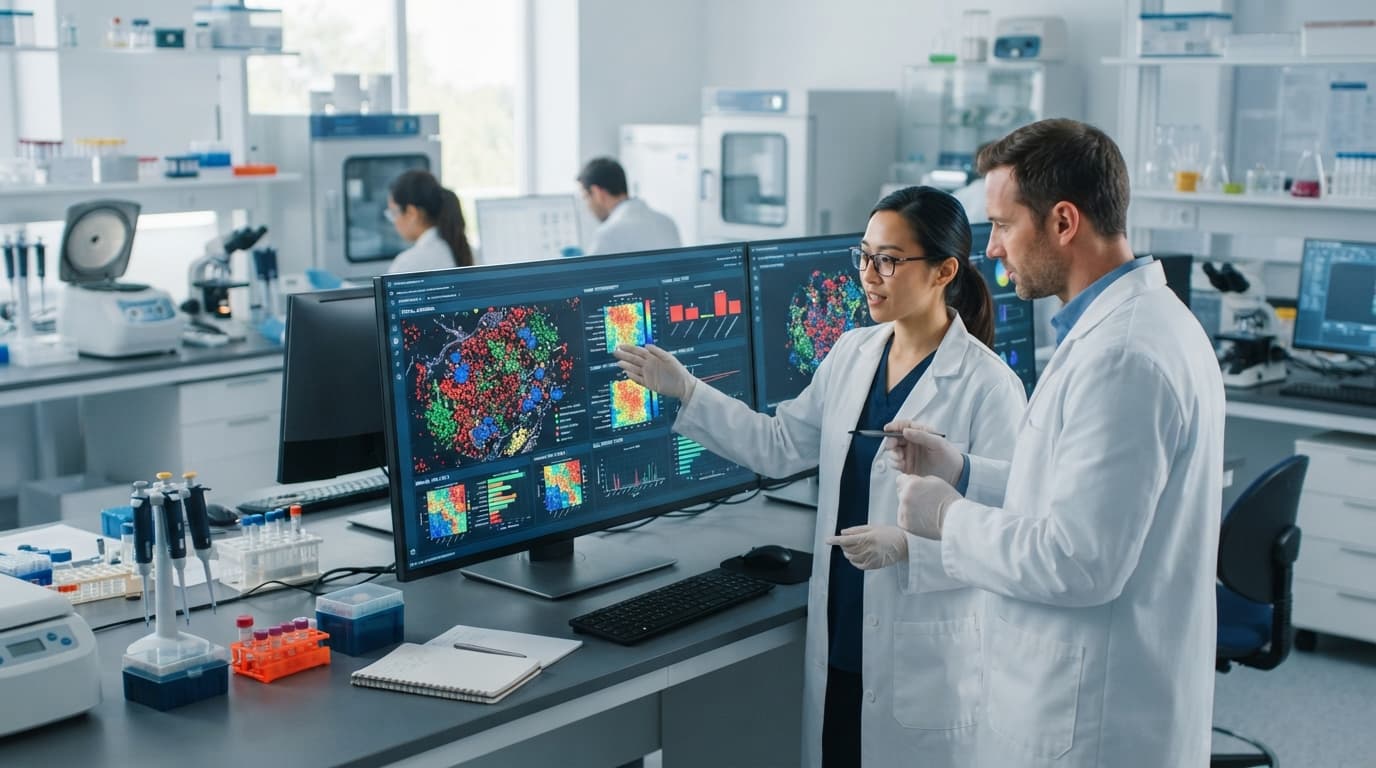
Noetik has hit the first research milestone in its multi-year AI oncology collaboration with GSK, one of the largest deals of its kind between an AI-native biotech and a major pharmaceutical company
The partnership, structured around upfront payment plus milestone-based payouts, was designed to test whether AI foundation models trained on spatial tumor data can meaningfully accelerate cancer drug discovery
The milestone offers an early, if narrow, signal of whether AI-first biotech models can deliver on promises that have so far outpaced proven results across the industry
Noetik, an AI-native biotechnology company focused on cancer research, has reached the first milestone in its collaboration with GSK, marking an early proof point in one of the pharmaceutical industry's most closely watched bets on artificial intelligence. The achievement matters less for its immediate scientific detail than for what it signals: a young AI drug-discovery company clearing a contractual checkpoint that determines whether a major pharmaceutical partner continues to trust its technology with real research decisions.
What the Milestone Actually Tests
The GSK-Noetik collaboration, announced in 2024, centers on Noetik's use of spatial multi-omic data and AI foundation models to build detailed computational representations of tumors. The goal is to identify novel drug targets and predict how patients might respond to therapies before those therapies ever reach a lab bench or a clinical trial.
Milestone-based biotech partnerships typically tie payments to specific research deliverables rather than simple timelines, meaning reaching the first checkpoint required Noetik's models to produce results that satisfied predefined scientific criteria set jointly with GSK. That structure is deliberate: it forces AI biotech companies to demonstrate tangible output rather than raise capital on the promise of future capability alone.
For an industry still working out how much confidence to place in AI-generated biological insights, hitting a defined milestone carries more weight than a general progress update. It suggests the underlying models produced findings GSK's own scientists judged credible enough to advance.
Financial terms of the original deal were substantial by industry standards, with the arrangement structured around upfront payment and the potential for well over a billion dollars in aggregate milestones tied to research and development progress across multiple disease targets.
AI Drug Discovery Clears First Real-World Test
Why Pharma Is Betting Heavily on AI Foundation Models
GSK's willingness to commit significant potential payouts to an early-stage AI biotech reflects a broader shift underway across the pharmaceutical sector. Large drugmakers have spent the past several years signing partnerships with AI-focused startups, betting that machine learning models trained on biological data can shorten the notoriously slow and expensive process of identifying viable drug targets.
Traditional drug discovery timelines routinely stretch beyond a decade, with the vast majority of candidate compounds failing before ever reaching approval. Foundation models trained on genomic, proteomic, and spatial tumor data represent an attempt to compress that timeline by narrowing the search space earlier, before costly laboratory and clinical work begins.
That thesis has parallels in other sectors racing to apply AI foundation models to specialized data, an approach examined in Saragon Bets on AI's Inference Shift, which looks at how companies outside biotech are restructuring around AI inference rather than traditional software development. In pharmaceutical research, the stakes of getting that bet right are considerably higher, given the regulatory scrutiny and clinical validation any resulting drug candidate must eventually pass.
GSK is not alone in pursuing this strategy; most major pharmaceutical companies now maintain multiple AI partnerships, though few have attached financial terms as large as those in the Noetik agreement.
What the Milestone Signals — and What It Doesn't
It is worth being precise about what clearing a first milestone actually demonstrates. It confirms that Noetik's models produced research output meeting agreed scientific standards at an early stage of the collaboration, not that any resulting drug candidate has been validated in patients or is close to clinical testing.
The broader pattern across health technology suggests genuine advances tend to arrive incrementally rather than through single breakthrough announcements, a dynamic also visible in adjacent fields such as diagnostic imaging, where handheld ultrasound device innovation has progressed through steady technical improvement rather than sudden leaps. AI-driven drug discovery is likely to follow a similarly gradual path, measured in successive milestones rather than a single transformative moment.
Skepticism remains warranted. The biotech sector has seen previous waves of AI-driven partnerships generate early enthusiasm that did not always translate into approved therapies, and investors and pharmaceutical partners alike have grown more disciplined about distinguishing genuine scientific progress from promotional momentum.
What makes this milestone notable is precisely that it is contractual and verifiable, rather than a self-reported claim of progress, giving outside observers a rare concrete data point in an otherwise opaque area of research.
Noetik's first milestone under its GSK collaboration represents an early but meaningful test of whether AI foundation models can deliver measurable progress in oncology drug discovery, rather than simply generating investor interest. Further milestones, and eventually clinical data, will determine whether the partnership's ambitious financial structure proves justified. For now, the industry is watching closely, aware that the gap between promising AI models and approved cancer therapies remains wide.
⭐
Business Spotlight
This article is a premium Business Spotlight feature — an in-depth profile with priority homepage placement. Contact us to be featured.
Stay Ahead of the News
Get the latest business news and company spotlights delivered to your inbox. No spam, unsubscribe any time.