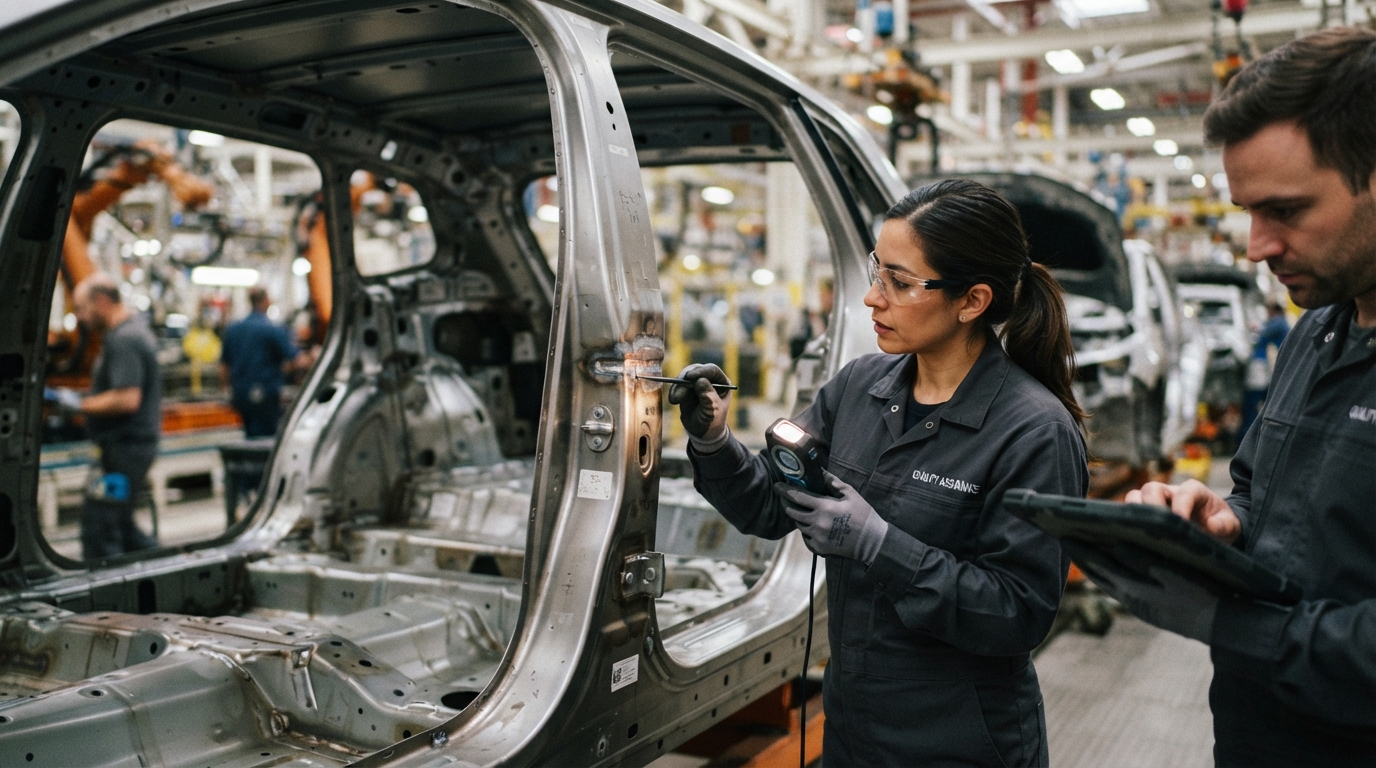
Demand for automotive pillars is rising alongside global passenger vehicle output, reflecting the parts' growing structural and safety importance
Automakers are shifting pillar materials toward high-strength steel, aluminum, and composites to balance crash protection with weight reduction
The trend intersects with electrification, as battery-electric platforms place new structural demands on body-in-white components
Global demand for automotive pillars — the vertical structural beams that support a vehicle's roof and frame around doors and windows — is expanding as passenger vehicle production recovers and diversifies worldwide. What might appear to be a niche corner of the auto parts industry is drawing renewed attention from suppliers and automakers alike, as pillars have become central to how manufacturers meet crash-safety standards while also cutting vehicle weight to improve range and efficiency.
Why Structural Components Are Gaining Strategic Weight
Pillars, labeled A, B, C, and sometimes D depending on their position along the vehicle body, were once treated as a straightforward structural formality. That has changed as regulators worldwide have tightened crash-test requirements, particularly around side-impact and rollover protection, forcing engineers to rethink how these components are designed and manufactured.
The B-pillar, positioned between the front and rear doors, has become especially critical because it must absorb and distribute crash energy without collapsing into the passenger cabin. Automakers now treat pillar design as a core safety engineering discipline rather than a secondary structural detail.
This shift has elevated the commercial importance of the suppliers who produce these components, many of which specialize in metal forming, hot stamping, and composite layup techniques. As vehicle platforms multiply across body styles and powertrains, the variety and volume of pillar components required has grown correspondingly.
Industry data compiled by the International Organization of Motor Vehicle Manufacturers shows global vehicle production has been on a broadly recovering trajectory in recent years following pandemic-era disruptions, providing the underlying volume growth that supports demand for structural body parts of all kinds.
Structural Body Parts See Quiet Boom in Auto Supply Chains
Lightweighting Pressures Reshape Material Choices
Perhaps the most consequential change in the pillar market involves materials. For decades, mild steel dominated pillar construction, but automakers have increasingly turned to advanced high-strength steel, aluminum alloys, and in some premium and electric models, carbon-fiber-reinforced composites.
The motivation is twofold: these materials can maintain or improve crash performance while reducing mass, which directly affects fuel economy in combustion vehicles and driving range in battery-electric ones. Hot-stamped boron steel, for example, has become common in B-pillars because it offers exceptional strength at reduced thickness compared with conventional steel grades.
This materials shift is not without complications. High-strength steels and aluminum require different welding, joining, and forming processes than traditional steel, meaning suppliers must invest in new tooling and expertise rather than simply scaling existing production lines.
That investment burden is contributing to consolidation pressure among smaller component makers who lack the capital to retool quickly, a dynamic that mirrors broader patterns across the auto parts sector where scale increasingly determines competitiveness.
Electrification Adds a New Layer of Structural Demand
The rise of battery-electric vehicles has introduced structural requirements that did not exist in the same form for combustion-engine cars. Battery packs are typically mounted low in the chassis, and pillars must now also help protect that battery in the event of a side impact, since damage to a battery pack carries fire and safety risks distinct from conventional fuel systems.
This has pushed some automakers toward pillar designs integrated more closely with the battery enclosure itself, blurring the line between traditional body-in-white engineering and battery-pack protection systems. Suppliers who can offer both capabilities are finding themselves better positioned commercially than those focused solely on legacy stamping.
Procurement patterns are shifting as a result, with automakers increasingly seeking suppliers who can co-develop components digitally before physical prototyping begins. That mirrors a wider transformation in industrial buying behavior, where B2B sourcing practices across manufacturing sectors have moved toward more digitally coordinated supplier relationships rather than purely transactional purchasing.
Regional production patterns also matter here. Automakers building electric models in multiple regions to serve local markets and meet local-content requirements are creating demand for pillar suppliers with manufacturing footprints close to final assembly plants, rather than relying solely on centralized global sourcing.
What the Trend Signals for the Broader Auto Supply Chain
The growth in pillar demand is best understood as one symptom of a larger structural transformation underway across vehicle manufacturing generally. As safety regulation, weight reduction, and electrification all converge on the same physical components, parts that were once commoditized are becoming differentiators in vehicle engineering and, by extension, in supplier competitiveness.
This dynamic rewards suppliers capable of materials science expertise and rapid design collaboration over those competing purely on manufacturing cost. It also raises the barrier to entry for new suppliers, potentially concentrating market share among established players with the capital to invest in advanced forming and joining technologies.
For automakers, the trend underscores how vehicle architecture decisions ripple outward through the supply chain, turning structural engineering choices into procurement strategy questions with multi-year implications for sourcing relationships and manufacturing footprints.
Taken together, the expansion of the automotive pillar market reflects broader forces reshaping vehicle manufacturing: tighter safety standards, the push for lighter and more efficient vehicles, and the structural demands introduced by electrification. As passenger vehicle production continues to grow across regions, suppliers capable of adapting materials and design approaches to these converging pressures are likely to see the strongest demand, while those slower to modernize may face increasing competitive strain.
⭐
Business Spotlight
This article is a premium Business Spotlight feature — an in-depth profile with priority homepage placement. Contact us to be featured.
Stay Ahead of the News
Get the latest business news and company spotlights delivered to your inbox. No spam, unsubscribe any time.