Click Below To Share & Ask AI to Summarize This Article
Save time and get the key takeaways instantly. Choose your favourite AI assistant to read and analyse this page for you.
At a Glance
- Dr. Tommy Rhee, a Tampa-based sports chiropractor and former U.S. Navy aviator, delivered a TEDx talk connecting science fiction to emerging medical technology
- Rhee has developed three connected platforms, RheeGen, Nuntius, and DeepLayer, exploring biological signaling and transdermal delivery
- RheeGen is being developed as a plant-based over-the-counter topical pain-relief product, built within standard OTC regulatory guidelines
For decades, science fiction has imagined a future where medicine becomes faster, smarter, less invasive, and increasingly personalized. Devices instantly evaluate the body, technology communicates with biology, and treatments that once required complex procedures become simpler and more accessible. For Dr. Tommy Rhee, those ideas are more than entertainment, they have helped shape the way he thinks about healthcare innovation.
That was the idea behind Rhee's TEDx talk, "From Tricorders to Cell Signaling: How Sci-Fi Is Rewriting Medicine," where he explored a simple question: how often does yesterday's science fiction become tomorrow's medicine? "Science fiction allows us to imagine what might be possible before we have the technology to actually do it," Rhee says. "What's fascinating is watching some of those ideas eventually become reality."
From Human Performance to Healthcare Innovation
Rhee's perspective comes from nearly two decades working in chiropractic care, sports medicine, rehabilitation, and human performance. His work has also evolved into the emerging field of topical regenerative medicine, where he has become a leading expert focused on biological signaling and transdermal delivery.
Before entering healthcare, he served in the U.S. Navy as an aviator. He later became a sports chiropractor and worked with athletes at multiple levels of competition, including serving as a team doctor for UCLA Athletics and the Tampa Bay Buccaneers. Today, Rhee practices in Tampa, Florida, where he has incorporated technologies ranging from photobiomodulation and shockwave therapy to whole-body vibration and hyperbaric oxygen therapy.
Years of working with patients and athletes eventually led him to a fundamental question: what actually tells the body what to do? The answer increasingly pointed him toward biological signaling.
Medicine Is Also About Communication
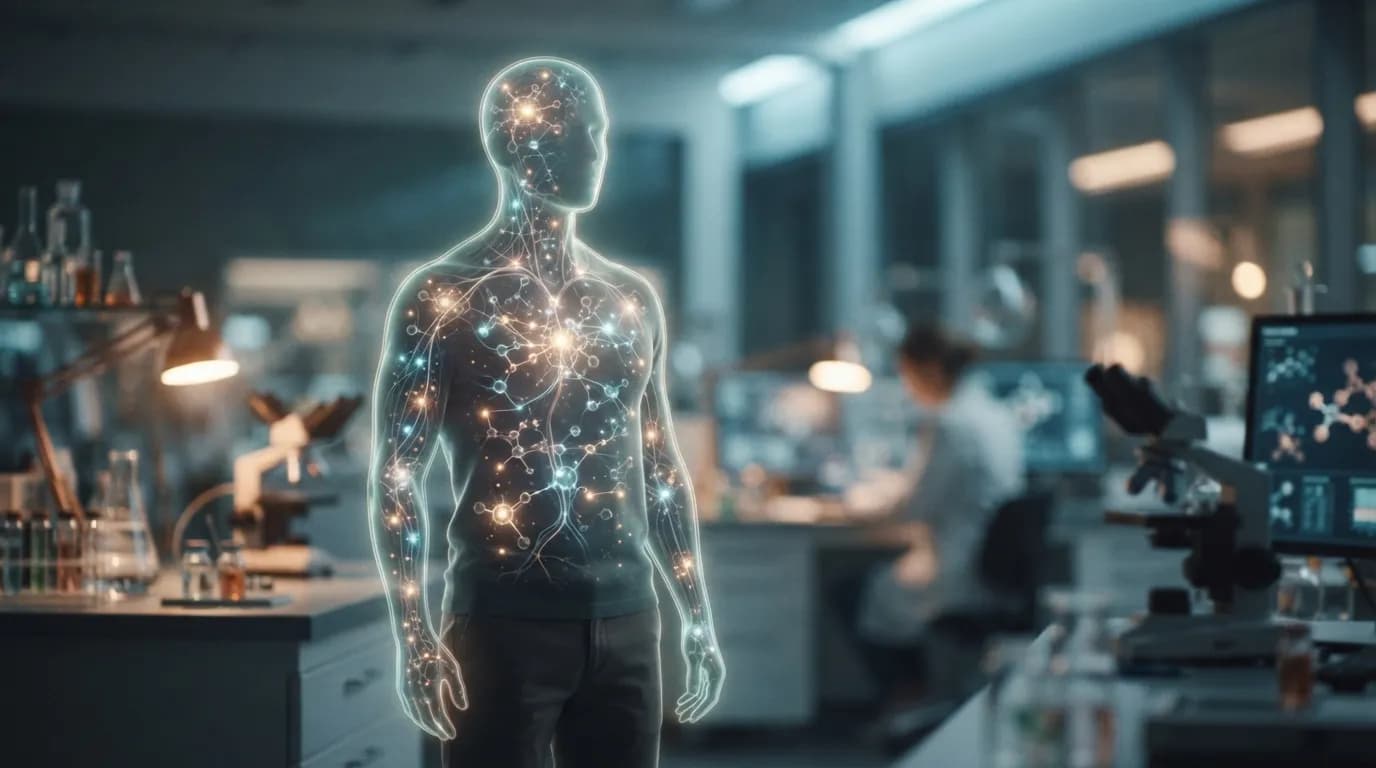
The human body is constantly communicating. Cells release signals. Receptors receive information. Molecular pathways turn on and off. Tissues respond to their biological environment. This communication influences many normal biological processes, including inflammation, metabolism, adaptation to exercise, and recovery.
Rhee became particularly interested in cellular signaling while studying developments in regenerative medicine. "The more I studied the science, the more I realized that the conversation wasn't only about cells," Rhee explains. "It was also about the signals those cells produce and how biological information is communicated." That realization changed the direction of his work, leading him toward two related questions: what biological signals should we study, and how can selected compounds be delivered where they are intended to go? Those two questions eventually led to the development of three connected platforms: RheeGen®, Nuntius™, and DeepLayer™.
Nuntius™: Exploring the Language of Biological Signaling
Plants produce thousands of biologically active compounds, many of which have been studied for their interactions with molecular pathways involved in normal cellular activity. Rhee became interested in selected plant-derived small molecules and their relationship with biological signaling, work that became the foundation for Nuntius™.
Rather than focusing on a single botanical ingredient, Nuntius represents Rhee's approach to combining selected plant-derived compounds based on their molecular characteristics and the biological pathways being studied. The concept reflects a larger shift in his thinking: the future of healthcare may not simply involve introducing something new into the body, but better understanding the signals already involved in normal biological processes. But identifying interesting compounds presented another challenge: how do you deliver them?
DeepLayer™: Solving the Delivery Problem
Human skin is an extraordinary protective barrier, good biology, but a major challenge for topical products. A compound may be biologically interesting, but that does not automatically mean it can effectively move through the skin. Molecular size, solubility, formulation, concentration, and the characteristics of the skin barrier all influence topical delivery.
This problem led Rhee to develop DeepLayer™, a DMSO-free transdermal delivery platform focused on the formulation and delivery side of the equation, how selected compounds can be incorporated into a topical system designed to improve movement across the skin barrier. Rhee describes the relationship between the technologies simply: "I realized there were really two questions. What signals do we want to study, and how do we deliver them? Nuntius™ grew out of the signaling question. DeepLayer™ grew out of the delivery question."
RheeGen®: Bringing the Two Ideas Together
RheeGen® represents the consumer-facing application where Rhee's work in botanical signaling and topical delivery comes together. The project has evolved significantly from Rhee's earlier research into mammalian-derived biological signaling. As the concept moved toward a consumer product, Rhee began exploring a different direction: whether selected plant-derived small molecules could form the basis of a scalable topical platform. That shift led to the current generation of RheeGen®, which is being developed as a plant-based over-the-counter topical pain-relief product.
The distinction is important. Rhee does not claim that an OTC topical product regenerates human tissue or functions as a stem-cell treatment. Instead, the commercial product is being developed within the appropriate OTC framework, while the underlying research continues to explore broader questions surrounding biological signaling and topical delivery. "There has to be a clear distinction between the science you're interested in and what you can responsibly say about a consumer product," Rhee says. "The research gives us questions to investigate. The product still has to follow the regulatory framework."
From the Treatment Room to the Laboratory
Rhee's path into product development was not something he originally planned. Years of treating patients and athletes exposed him to a recurring challenge: many healthcare technologies can be expensive, invasive, difficult to access, or dependent on specialized equipment. He began wondering whether some ideas being explored in advanced medicine could eventually become simpler and more accessible, which brought him back to science fiction.
The fictional medical tricorder from Star Trek represented an extraordinary idea when it first appeared: a handheld device capable of rapidly gathering information about someone's health without invasive testing. Today, wearable devices continuously monitor heart rate, oxygen saturation, sleep, movement, temperature, and other physiological information, and artificial intelligence is increasingly being incorporated into medical imaging, research, and clinical decision support. The tricorder did not arrive exactly as science fiction imagined it, but the direction is recognizable. Rhee believes biological signaling and advanced topical delivery may represent another area where today's early research could influence tomorrow's healthcare technologies.
Imagining What Comes Next
For Rhee, the TEDx talk was ultimately not about predicting a particular invention. It was about being willing to ask questions that may initially sound unconventional. "What we consider normal medicine today would have looked like science fiction to someone 100 years ago," Rhee says. "MRI, robotic surgery, wearable health monitors, telemedicine, somebody had to imagine these things before they became part of everyday healthcare."
That philosophy now drives his work with RheeGen®, Nuntius™, and DeepLayer™. Together, the three platforms represent a progression of ideas: Nuntius™ explores the signals, DeepLayer™ explores the delivery, and RheeGen® brings those concepts together in a consumer-facing topical platform. The question driving Rhee remains remarkably simple: if biology communicates through signals, how might we better understand, and someday better utilize, that communication? It is a question that sits somewhere between biology, technology, and imagination, and if history is any indication, that is often where innovation begins.
Stay Ahead of the News
Get the latest business news and company spotlights delivered to your inbox. No spam, unsubscribe any time.
We respect your privacy. Unsubscribe at any time.