Click Below To Share & Ask AI to Summarize This Article
Save time and get the key takeaways instantly. Choose your favourite AI assistant to read and analyse this page for you.
At a Glance
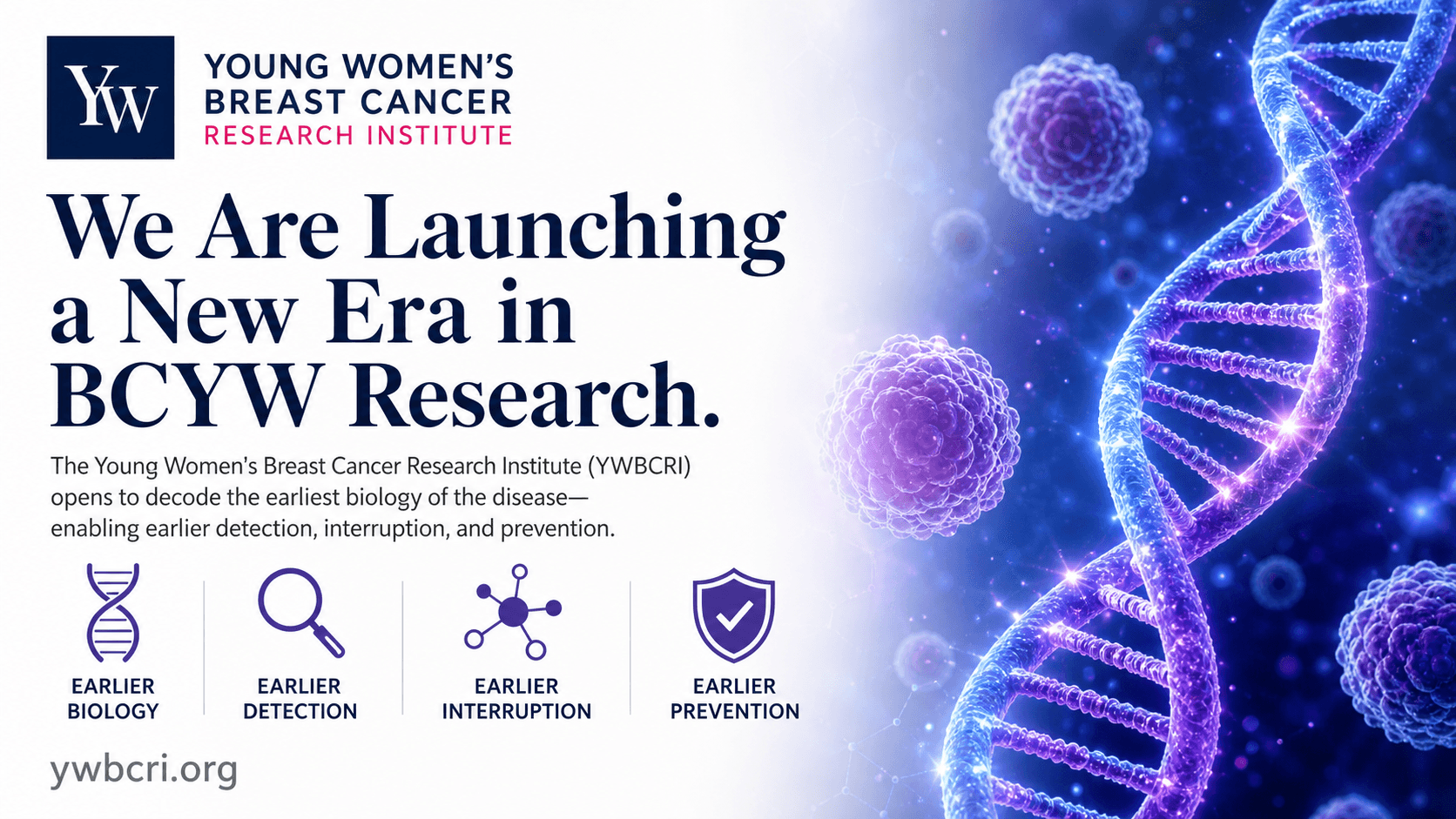
The Young Women's Breast Cancer Research Institute (YWBCRI) launches as the first institute dedicated to early breast cancer biology in young women.
YWBCRI is built on the hypothesis that early-onset breast cancer may begin long before a tumour appears — and may be detectable, interruptible, and potentially preventable.
Four hub sites are being established across the USA, Europe, South Asia, and East Asia, with Amsterdam set to join as a fifth hub.
The Institute transitions BCYWF's mission from awareness and education into active discovery science.
The Breast Cancer in Young Women Foundation (BCYWF), USA, has announced the launch of the Young Women's Breast Cancer Research Institute (YWBCRI) — the first institute of its kind dedicated entirely to advancing breast cancer research for young women by moving science earlier, before cancer becomes clinically visible. Launched from Denver, Colorado, the Institute is designed to address a critical and largely unexamined gap: why breast cancer develops early in some women, what biological changes occur in the transition from pre-cancerous state to diagnosis, and how science may one day help detect, interrupt, and prevent the disease before it takes hold.
"BCYW Foundation was created to advance research on breast cancer in young women, with early biology central to its mission. With YWBCRI, we are extending that mission into discovery science — building the infrastructure to understand the disease earlier and to change its future."
— Rakesh Kumar, PhD, Founding Institute Scientific Director, YWBCRI, and Founder & CEO, BCYWF
A Field-Defining Scientific Hypothesis
Unlike conventional research models that begin after a tumour is detected, YWBCRI is built to advance discovery upstream. Its central hypothesis is that early-onset breast cancer may begin long before a tumour appears — when normal biology quietly goes awry. By concentrating on early biological signals, tissue context, biological timing, systemic changes, and the transition from normal biology to disease, the Institute aims to create the first dedicated scientific platform for earlier understanding of breast cancer in young women.
If this hypothesis is correct, early-onset breast cancer is not simply an unpredictable event that begins at diagnosis. It may be a biological process that develops over time — and therefore one that is detectable, interruptible, and potentially preventable.
"For too long, breast cancer in young women has been approached mainly after the disease becomes visible. YWBCRI asks a different question: what happens before the tumour appears? Awareness tells young women that breast cancer can happen. Research must now tell us why it happens, when it begins, and how we can stop it earlier."
— Rakesh Kumar, PhD, Founding Institute Scientific Director, YWBCRI
Four Hub Sites, One Shared Mission
YWBCRI is being established with four hub sites across the USA, Europe, South Asia, and East Asia, forming a collaborative research network that links laboratory discoveries, clinical insights, biospecimen-based studies, early detection initiatives, and international academic partnerships. Each site contributes to a shared mission while recognising region-specific patterns, subtypes, and biological differences in breast cancer among young women.
The four founding institute sites and their directors are:
YWBCRI-DHR Health, Texas, USA — Carlos García-Cantú, MD, Chief, Department of Surgery and Chairman, DHR Health NAPBC Breast Center of Excellence
YWBCRI-FMUL, University of Lisbon, Europe — Prof. Luis Costa, Clinical Director of YWBCRI and Chairman of Oncology, Faculty of Medicine, University of Lisbon
YWBCRI-KUMP Tokyo, East Asia — Masakazu Toi, MD, PhD, Director, Tokyo Metropolitan Cancer and Infectious Disease Center
YWBCRI-Medanta, Gurugram, India, South Asia — Ashok K. Vaid, MD, DM, Chairman, Medanta Cancer Institute
A fifth hub is also anticipated. Dr. Marie Jeanne Vrancken Peeters, MD, PhD, Professor at the Netherlands Cancer Institute and Amsterdam University Medical Center, and a member of the YWBCRI Executive Committee, confirmed: "Research on breast cancer in young women is essential because breast cancer can affect women at any age. Early detection saves lives, and an international institute with a global network of hubs can accelerate innovation, deepen biological insight, and improve outcomes for young women worldwide. We are dedicated to this mission and look forward to Amsterdam joining the YWBCRI as a fifth hub as soon as possible."
Why This Institute Was Needed
Breast cancer in young women is not simply breast cancer occurring earlier on the calendar. It often intersects with reproductive biology, dense breast tissue, pregnancy and postpartum changes, hereditary risk, delayed diagnosis, aggressive tumour features, fertility decisions, parenting, career development, and long-term survivorship — a constellation of factors that make it a biologically and clinically distinct challenge. Yet young women remain underrepresented across many research frameworks, screening strategies, prevention models, and biological studies.
"The launch of YWBCRI represents a pivotal milestone in breast cancer research for young women. By targeting the earliest biological changes that might occur before the disease becomes clinically apparent, YWBCRI establishes a new platform for discovery, collaboration, and translational research. As a global institute, it uniquely unites leading scientists, clinicians, and research facilities around a common goal: to detect breast cancer earlier in young women than ever before."
— Prof. Luis Costa, Clinical Director, YWBCRI, and Director, YWBCRI-FMUL Lisbon, and Chairman of Oncology, Faculty of Medicine - University of Lisbon.
Dr. Paul Fisher, Professor and Thelma Newmeyer Corman Endowed Chair of Cancer Research at the VCU Massey Comprehensive Cancer Center and a member of the YWBCRI Scientific Advisory Board, underscored the urgency: "Research on diseases with smaller affected populations often receives limited priority. This is especially true for breast cancer in women under 40, which can be aggressive, biologically complex, and difficult to treat. The establishment of the Young Women's Breast Cancer Research Institute, which brings together top scientists, physician-scientists, and clinicians focused on this unmet need, is a significant and timely step forward."
The Institute's global reach reflects the universal nature of the challenge. "Young women's breast cancer prevention, early detection, improved treatment outcomes, enhanced survival, and better quality of life are increasingly recognised as critical priorities for women across Asia," said Masakazu Toi, MD, PhD. "Breast cancer in young women is an increasingly important clinical challenge in India, where earlier recognition, risk understanding, and prevention-focused research are critically needed," added Ashok K. Vaid, MD, DM. In Texas, Carlos García-Cantú, MD, emphasised that "building a care team passionate about rigorous research and compassionate patient care is essential not only for producing scientific reports but also for patient survival and well-being — especially critical when caring for young breast cancer patients, whose needs extend significantly beyond older populations."
From Awareness to Discovery
BCYWF has built a global platform for breast health education, youth engagement, professional collaboration, scientific meetings, international outreach, and public awareness focused on breast cancer among young women — bringing together a network of scientists, oncologists, surgeons, survivors, NGOs, and partners from 35 countries. The Foundation also publishes the peer-reviewed, open-access Journal of Young Women's Breast Cancer and Health. YWBCRI represents the next major evolution of that mission — transforming awareness into discovery. Its goal is not only to improve treatment after diagnosis but to help create a future in which breast cancer in young women can be recognised earlier, understood more deeply, and prevented more effectively.
For media enquiries and further information, contact Rakesh Kumar, PhD at rakeshkumar@ywbcri.org or +1 303-900-8066. Further information is available at ywbcri.org and bcywfoundation.org.
Stay Ahead of the News
Get the latest business news and company spotlights delivered to your inbox. No spam, unsubscribe any time.
We respect your privacy. Unsubscribe at any time.