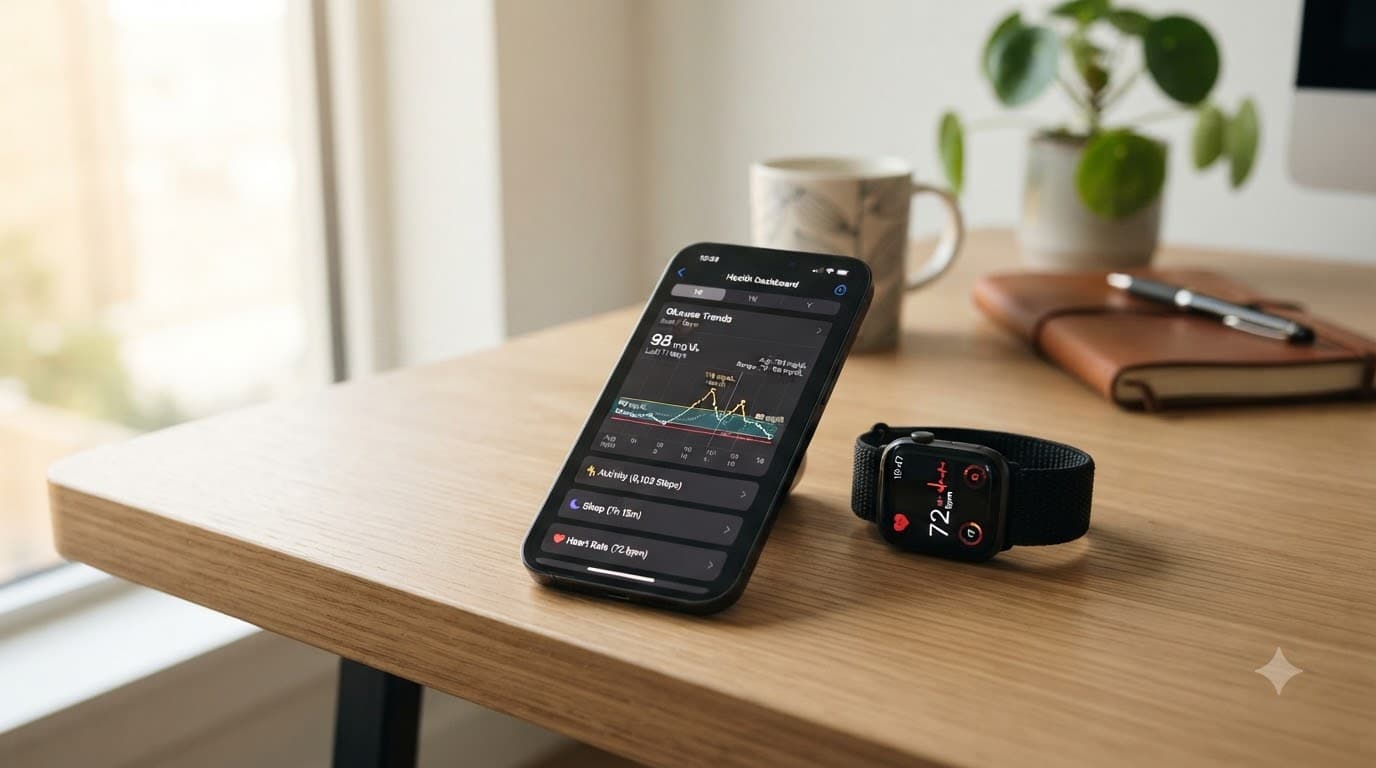
January AI's updated app merges medical records, wearable data, and glucose prediction without requiring a continuous glucose monitor
The company positions itself as the first free health app to combine these three data streams in one interface
The move reflects a broader shift toward predictive, data-driven consumer health tools amid rising interest in metabolic health
January AI has released a major update to its health app, positioning it as the first free offering to combine one-tap medical record access, predictive glucose technology that does not require a continuous glucose monitor (CGM), and wearable device data in a single platform. The update arrives as consumer demand for accessible metabolic health tools continues to climb, and as companies race to lower the cost and friction of monitoring blood sugar trends without invasive hardware.
Removing the Hardware Barrier
Continuous glucose monitors have become a familiar sight among people managing diabetes, but their cost and the need for skin-worn sensors have limited adoption among the broader population interested in metabolic health. January AI's predictive glucose feature is built to estimate blood sugar responses using existing data points rather than a physical sensor, removing what has historically been the single biggest barrier to entry.
By pairing this prediction engine with wearable data, the app can factor in signals such as heart rate, sleep, and activity levels that influence glucose response. Combining these inputs with medical records adds a further layer, allowing the app to contextualize predictions against a user's documented health history rather than treating each data stream in isolation.
The one-tap medical record retrieval feature is aimed at a persistent pain point in digital health: the fragmentation of patient data across providers, insurers, and testing labs. Consumers frequently struggle to compile a complete health picture without manually requesting records from multiple sources, a friction point that has slowed adoption of many otherwise capable health apps.
Making all three capabilities available for free, rather than behind a subscription or hardware purchase, distinguishes January AI's approach from many competitors in the digital health space, where premium tiers and proprietary sensors have typically been the norm.
Free App Bets Health Data Beats the Needle
A Crowded but Fast-Growing Market
Metabolic health has become one of the more active corners of consumer technology in recent years, driven partly by growing public interest in blood sugar stability, weight management, and the broader conversation around GLP-1 medications. Established CGM makers such as Abbott have expanded their over-the-counter glucose monitoring lines, while a wave of software-first entrants has tried to differentiate through data interpretation rather than sensor hardware.
January AI's decision to build predictive capability without a CGM sets it apart from companies whose business models depend on selling or partnering around physical sensors. This approach could appeal to users who are curious about their metabolic patterns but are unwilling to wear a device on their arm for weeks at a time, or who live in regions where CGMs are costly or difficult to obtain without a prescription.
The broader trend points toward health platforms consolidating disparate data sources into single dashboards, an approach mirrored in other sectors where fragmented information systems have historically frustrated users. That pattern is discussed in the context of enterprise technology in a recent feature on how data ecosystems redraw enterprise playbook, a dynamic increasingly visible in consumer health as well, where the value of an app often depends less on any single feature than on how well it unifies existing data.
Why the Free Model Matters
Offering this combination of features at no cost carries strategic weight beyond consumer goodwill. Free tiers have proven effective in digital health for building large user bases quickly, generating the kind of engagement and behavioral data that can later inform premium offerings, employer partnerships, or research collaborations.
It also lowers the barrier for a wider demographic to engage with metabolic health tracking, including people who might never have purchased a CGM or paid for a subscription-based wellness app. Wider access to predictive glucose insight, even in an early or approximate form, could meaningfully shift how many people first encounter the concept of monitoring their blood sugar trends.
At the same time, the sustainability of a free model raises questions common across digital health. Companies offering no-cost access to sophisticated prediction tools typically need a path to monetization, whether through data partnerships, premium add-ons, or eventual enterprise and insurer deals, and how January AI balances free access with long-term revenue will be worth watching.
January AI has combined its predictive glucose approach with the one-tap medical record and wearable integration to create what it describes as the first free app of its kind, a milestone that reflects both competitive pressure in digital health and genuine consumer appetite for simpler, less invasive ways to understand metabolic health, with the app's actual impact likely to depend on prediction accuracy and sustained user engagement over time.
⭐
Business Spotlight
This article is a premium Business Spotlight feature — an in-depth profile with priority homepage placement. Contact us to be featured.
Stay Ahead of the News
Get the latest business news and company spotlights delivered to your inbox. No spam, unsubscribe any time.