Click Below To Share & Ask AI to Summarize This Article
Save time and get the key takeaways instantly. Choose your favourite AI assistant to read and analyse this page for you.
At a Glance
Unanimous AI enabled the first-ever large-scale debate among human forecasters and AI agents. The topic they debated: Who Will Win the 2026 World Cup?
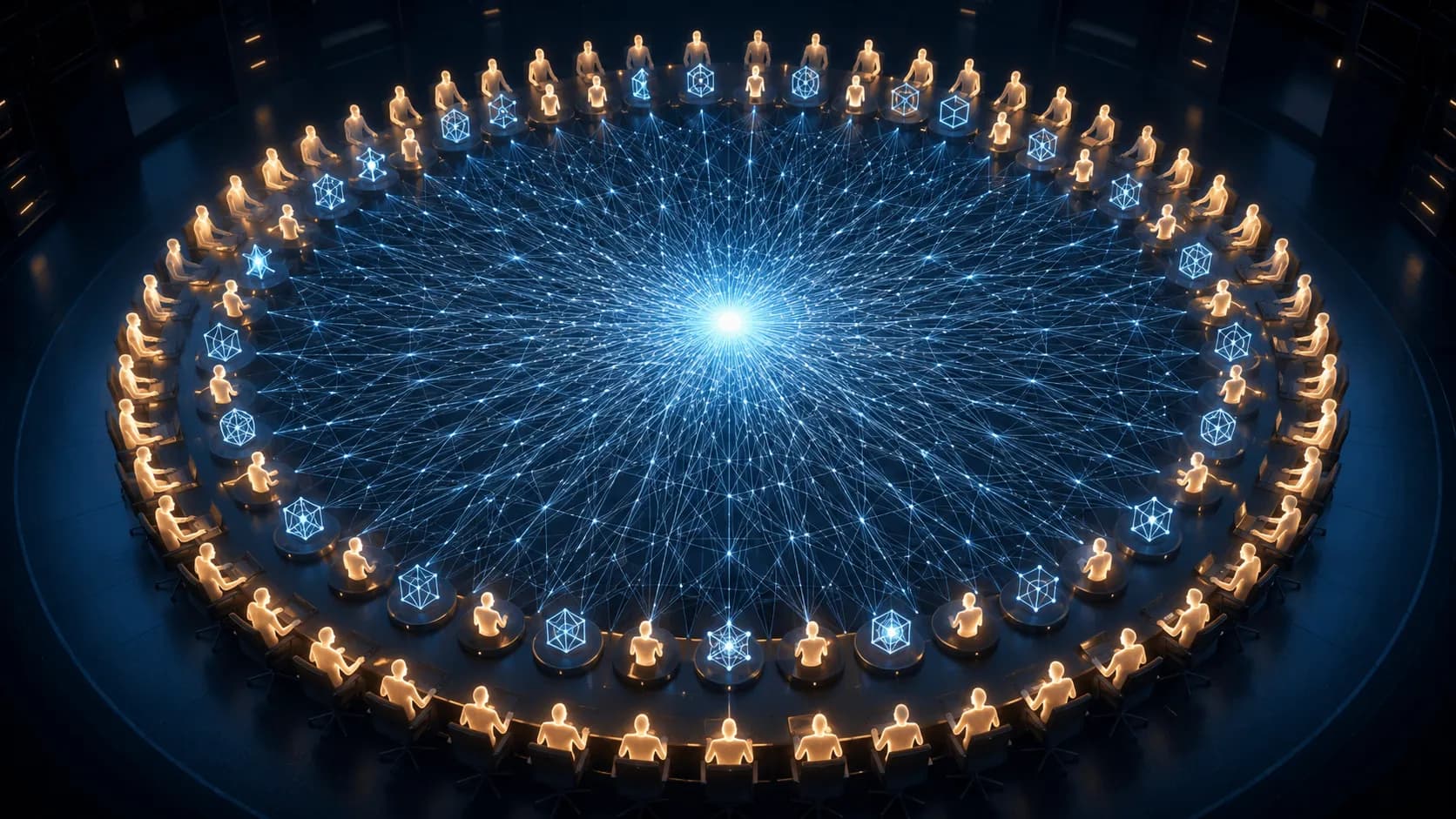
The 55-participant session — 44 human forecasters and 11 AI agents — was conducted using Thinkscape®, Unanimous AI's hyper-communication platform.
The group picked Spain as the most likely 2026 World Cup winner, with significantly more conviction than current prediction markets suggest.
Over 90% of human participants rated the AI agent contributors as genuinely helpful to the group deliberation.
On the surface, Unanimous AI's latest announcement looks like a sports prediction story. A group of 55 participants — 44 human soccer fans and 11 AI agents — debated the 2026 FIFA World Cup for 40 minutes and concluded that Spain is the most likely winner. But the prediction is almost beside the point. What Unanimous AI actually demonstrated on June 12, 2026, was something that had never been done before in the history of artificial intelligence: a large group of humans and AI agents holding a real-time conversational debate, arguing with evidence and reasoning, and converging together on a unified answer.
"What you're seeing here is the first time a large group of humans and AI agents have ever held a real-time meeting together. When you bring together 44 sports fans who intuitively know football and have them mix it up with each other and with AI agents who view the sport with statistical rigour, the output isn't just a list of opinions — it surfaces the most compelling evidence and reasoning — a true hybrid intelligence of humans and AI."
— Dr. Louis Rosenberg, CEO and Chief Scientist, Unanimous AI
The Problem With How We Currently Use AI
Most artificial intelligence applications follow a familiar pattern: a human asks a question, and the AI produces an answer. The human is a prompt-giver. The AI is a response engine. The exchange is sequential and asymmetric — and critically, it is not deliberative. No argument is made. No counterpoint is offered. No collective reasoning emerges.
Unanimous AI was founded on a different philosophy entirely. Rather than building AI that replaces human judgment, the company has spent over a decade building AI that connects human judgments together — amplifying what groups of people can think, decide, and forecast when their intelligence is properly networked. The result is a body of patented technologies — Swarm AI®, Hyperchat AI™, and AgentSwarm™ — that treat collective intelligence as a resource to be cultivated, not replaced. Over 25 published academic studies have validated the approach. Stanford University showed that medical teams using Swarm AI technology reduced diagnostic errors by over 30%. Oxford University showed that financial traders increased forecast accuracy by over 20%.
The Thinkscape Platform and How It Works
The World Cup prediction was produced using Thinkscape®, Unanimous AI's cloud-based collaboration platform. Thinkscape is powered by Hyperchat AI — a hyper-communication technology that enables groups of any size (up to 250 participants) to hold structured real-time deliberations by text, voice, or video. Unlike a survey or a prediction market, which reduces each person to a data point, Thinkscape enables participants to make arguments, respond to counterarguments, and refine their positions through genuine exchange. The platform continuously assesses the quality and persuasiveness of arguments as the discussion unfolds, helping the group converge on conclusions that reflect the weight of evidence rather than simply the majority view.
A recently published study compared Hyperchat AI technology directly to large-scale prediction markets and found that groups of just 25 people engaged in Hyperchat AI conversations outperformed Polymarket in sports forecasting — even though Polymarket aggregates hundreds of traders. The mechanism is deliberation: when people argue with evidence rather than simply express preferences, the signal-to-noise ratio in the collective output improves substantially.
The World Cup Session: What Actually Happened
For the 2026 World Cup prediction, Unanimous AI assembled 55 participants — 44 human sports fans with genuine domain knowledge of international football and 11 proprietary "Contributor Agents," AI systems designed to actively participate in group discussions by offering their own points and counterpoints in real time. This was not a case of AI agents summarising human input after the fact, nor humans rating AI-generated suggestions. The agents participated in the debate as active contributors, alongside the humans, for the full 40-minute session.
The group was tasked with debating which team was most likely to win the 2026 World Cup by arguing relative team strengths with evidence and reasoning. The result was what Unanimous AI describes as a "Hybrid Collective Intelligence" — a form of collective reasoning that combines the intuitive, contextual knowledge of experienced human fans with the statistical rigour and analytical depth of AI agents operating simultaneously within the same deliberative space.
The Forecast: Spain, With Conviction
The Hybrid Collective Intelligence's verdict was unambiguous: Spain is the most likely winner of the 2026 World Cup. The group cited Spain's exceptional squad depth, midfield control anchored by Rodri and Pedri, and Lamine Yamal as a decisive X-factor. Tactical cohesion and Spain's ability to manage the tournament's heat conditions were identified as additional differentiating advantages.
France finished second with a Scaled Ranking of 2.22, followed by Argentina at 6.08. The gap between Spain and France is particularly striking in the context of current prediction markets — on both Polymarket and Kalshi, Spain and France carry nearly equal odds. The Hybrid Collective Intelligence appears to have surfaced a level of conviction about Spain's dominance that the broader market has not yet reflected. The group's full top four projection includes Spain, France, Argentina, and England, with Portugal, Brazil, Germany, and Morocco receiving meaningful consideration.
The session also produced a notable dark horse pick: Norway. The group credited Norway's elite attacking firepower — led by Erling Haaland and Martin Ødegaard — high-scoring qualifying form, and the quality of their squad across European club football. While concerns about over-reliance on Haaland and limited World Cup experience were raised and debated, the collective concluded that Norway's individual brilliance gives them a realistic path to knockout stage wins.
What Made the AI Agents Different
The Contributor Agents used in this session are a proprietary Unanimous AI development. Unlike standard large language models queried individually, these agents were designed specifically to function as participants in multi-party deliberations — listening to the evolving discussion, formulating contextually appropriate arguments, responding to counterpoints raised by other participants (human or AI), and contributing to the group's convergence. The goal was not for the agents to dominate the discussion or to serve as a fact database, but to participate as peers in a reasoning process.
The human participants appeared to recognise the difference: over 90% of the human forecasters reported that the AI agent contributors were genuinely helpful to the group deliberation — a level of acceptance that suggests the agents were experienced as collaborative partners rather than as tools or noise.
The Bigger Picture: AI That Connects Rather Than Replaces
The World Cup experiment is a demonstration, not a product launch. Its significance lies in what it proves is technically possible, and in the philosophy it embodies. Unanimous AI's founding premise — that AI should not replace people, but connect them — has been the company's north star since its founding. The Swarm AI and Hyperchat AI technologies were built on the biological principle that networked groups of individuals, when properly connected, can outperform any single expert or any individual AI system. The 2026 World Cup session extends that principle into new territory: not just networked humans, but networked humans and AI thinking together in real time.
Unanimous AI's platforms are already used by Fortune 1000 companies, the US Air Force, the Department of Energy, the United Nations, and Harvard University. The Thinkscape platform supports enterprise collaboration at scale — group meetings, brainstorming, forecasting, decision-making, and market research — for up to 250 simultaneous participants. What the World Cup session adds is the first public demonstration that AI agents can be genuine participants in that collaborative process, not just tools in the background.
A short video demonstrating the session and its results is available here. For further information about Thinkscape and Unanimous AI's full technology suite, visit unanimous.ai. Media enquiries should be directed to info@unanimous.ai.
Stay Ahead of the News
Get the latest business news and company spotlights delivered to your inbox. No spam, unsubscribe any time.
We respect your privacy. Unsubscribe at any time.