
At a Glance
- Quorum Innovations publishes the first human study demonstrating that Qi601 physically binds microplastics in the human mouth.
- Laboratory digestion studies show approximately 98% of bound nano- and microplastics remain associated with Qi601 through simulated gastrointestinal transit.
- Qi601 reduced epithelial exposure and intracellular uptake of nanoplastics in intestinal barrier studies, introducing a new "transepithelial barrier gradient" approach.
- The research originated from a DARPA-commissioned project to develop biological barrier protection for warfighters against chemical and biological threats.
Researchers at Quorum Innovations have published the first human study demonstrating that a technology designed to physically bind microplastics in the human body is feasible. The study evaluated Qi601 — commercially available as My Gut Guardian — a novel non-living postbiotic derived from a heat-inactivated Lactobacillus fermentum biofilm. In a first-in-human proof-of-concept chewing gum study, Qi601 demonstrated visible binding of microplastic particles released during chewing, with follow-on laboratory digestion studies showing approximately 98% of those bound particles remained associated with the postbiotic through simulated gastrointestinal transit.
"A newly released scientific study reports the first published demonstration that a technology designed to physically bind microplastics in humans is feasible."
— Dr. Eva Berkes, Quorum Innovations
The Microplastics Problem
Micro- and nanoplastics are now recognised as ubiquitous dietary and environmental contaminants, present in food, drinking water, and increasingly detected in human tissues. With an estimated 400 million tonnes of plastics produced per year, and particles becoming progressively smaller — and therefore increasingly capable of penetrating human tissue and entering systemic circulation — the scale of human microplastic exposure is not diminishing. Despite growing scientific concern about the long-term health implications of chronic microplastic exposure, no safe, ingestible technology had previously demonstrated the ability to physically capture and retain these particles within the human digestive system — until now.
What the Study Found
The first-in-human component of the research was conducted as a 16-participant interventional crossover chewing gum study. Under microscopic analysis, Qi601 visibly bound with heterogeneous microplastic fragments released from gum during mastication, demonstrating that the postbiotic can engage microplastics at the earliest point of entry into the body — the mouth. This addresses exposure before particles have the opportunity to travel further into the gastrointestinal tract.
Follow-on laboratory digestion simulations then exposed Qi601-bound nanoplastics to sequential saliva, gastric, intestinal, and colonic digestive conditions. Approximately 98% of bound nano- and microplastics remained associated with Qi601 throughout this entire simulated transit — compared with untreated controls — confirming that the binding matrix is durable across the full digestive environment, not just at the point of initial capture.
Intestinal Barrier Protection
Beyond binding, the study also used advanced multimodal imaging — including confocal microscopy, atomic force microscopy, and scanning electron microscopy — to examine what happens at the intestinal wall. In Caco-2 intestinal epithelial monolayer studies, Qi601 reduced both surface-associated and intracellular nanoplastic burden, in both protection and rescue models. This means Qi601 decreased epithelial particle interaction whether applied before or after nanoplastic exposure — a finding with significant implications for the practical use case of reducing gut absorption.
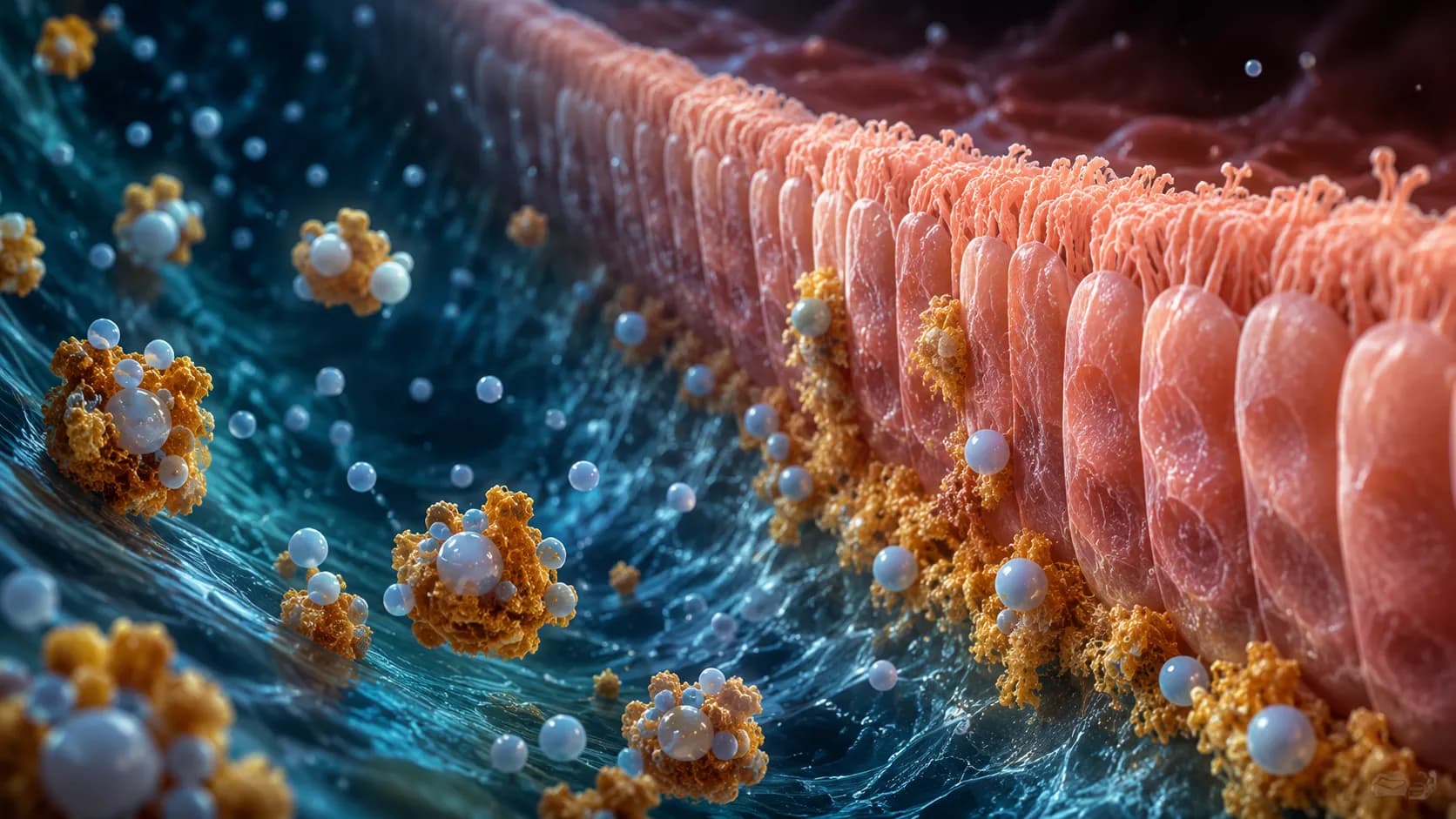
These findings support what Quorum Innovations describes as a "transepithelial barrier gradient" approach — a new paradigm for preventing microplastic absorption through microbiome-inspired physical defence rather than systemic intervention. The underlying mechanism is structural: Qi601's biofilm-derived surface forms small, rough clusters that physically surround and trap plastic particles, preventing them from attaching to intestinal cells.