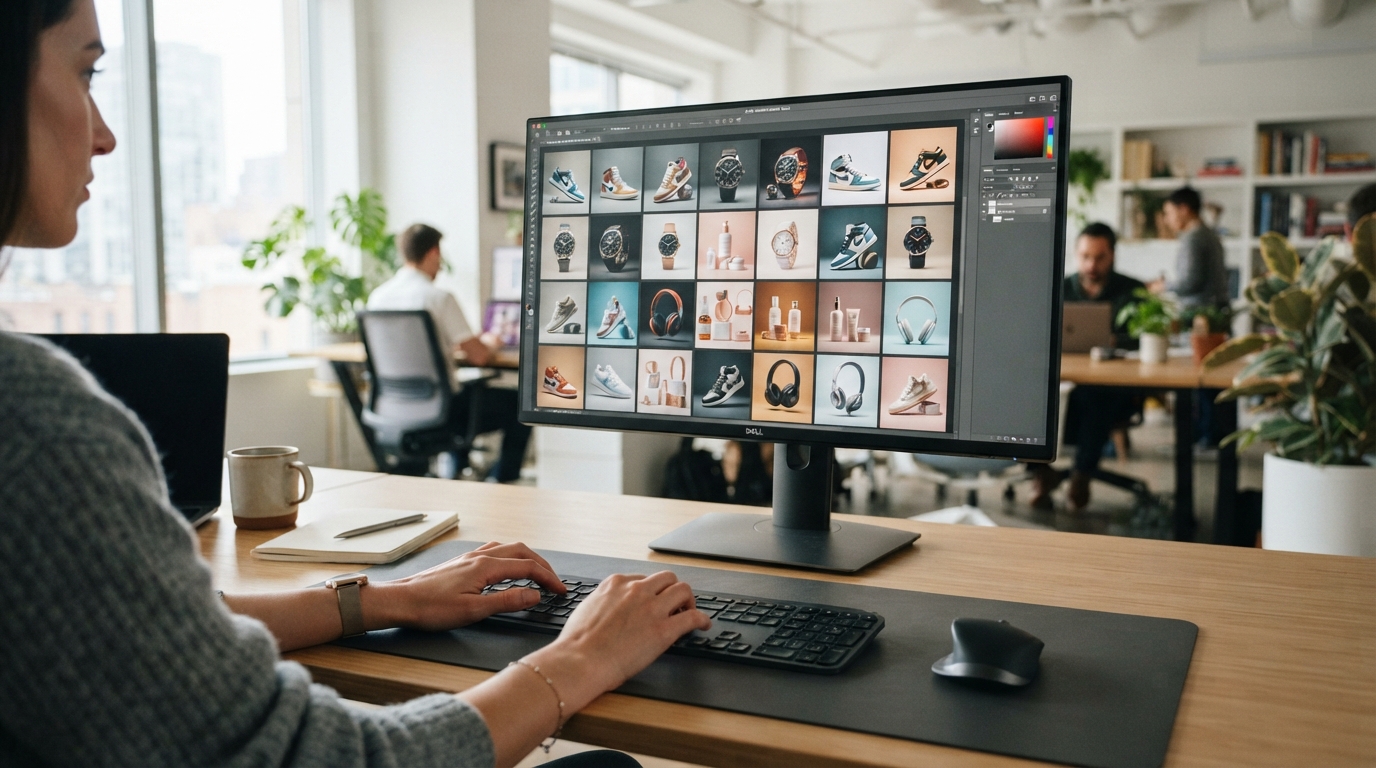
AI-generated product imagery is displacing traditional photo studios for a growing share of online sellers
The shift reflects broader pressure on retailers to cut fixed costs while maintaining visual quality standards
Analysts note the trend raises questions about authenticity, returns rates and long-term brand trust
Online retailers spend heavily on product photography before a single item ever reaches a shopper's screen, and that cost structure is now being challenged by artificial intelligence tools that can generate polished product images without a studio, a photographer or a physical shoot. The shift is quietly reshaping how small and mid-sized ecommerce businesses budget for visual content, at a moment when margins across the sector remain under sustained pressure.
Why Product Imagery Has Become a Cost Problem
Traditional ecommerce photography involves renting studio space, hiring photographers and stylists, and often shipping physical samples across borders for a shoot. For sellers with large or fast-changing catalogues, that cost is recurring rather than one-off, since new seasons, colourways and product variants each require fresh imagery.
Marketplaces and shoppers increasingly expect multiple angles, lifestyle context shots and zoom-ready detail for every listing, which multiplies the workload rather than shrinking it. Businesses selling across several regions face an added complication: imagery that fits one market's aesthetic or model diversity expectations may need reshooting for another.
This is the gap AI image generation tools are targeting. Instead of physically photographing a product against a backdrop, sellers can now upload a base image and generate variations, backgrounds or model placements digitally, cutting both the time and the marginal cost of producing new visual assets.
AI Photo Tools Rewrite Ecommerce Cost Math
Quality Versus Speed: The Central Trade-off
The core promise of AI product photography is not simply cheaper images but faster iteration. A retailer testing which background colour or lifestyle setting converts best can generate several versions in the time it once took to schedule a single studio session.
That speed matters more than it might seem. Ecommerce operators frequently run split tests on listing images, and the cost of traditional photography has historically limited how much experimentation was practical. Lowering that cost barrier means more sellers can treat imagery as something to be optimised continuously rather than finalised once.
The trade-off, industry observers note, is consistency and trust. Shoppers who feel misled by an image that oversells a product's appearance are more likely to return it, and repeated returns erode the very cost savings AI-generated imagery is meant to deliver.
A Familiar Pattern Across Visual Industries
The debate playing out in ecommerce mirrors one already underway in adjacent creative fields. In the entertainment industry, questions about how far AI-generated imagery can replace traditional photography while preserving authenticity have prompted some providers to build human review directly into their workflow, as seen in the approach detailed in AI headshots for actors adding human oversight. Ecommerce sellers are arriving at a similar conclusion: automation can handle volume, but a layer of human judgment still matters where brand reputation is at stake.
Retail analysts covering generative AI adoption have flagged similar tension between efficiency gains and quality control, a theme explored in McKinsey's research on generative AI in retail. The consistent finding across these discussions is that AI tools tend to succeed when they compress the expensive, repetitive parts of a workflow rather than remove human oversight entirely.
For ecommerce specifically, this suggests the winners will not necessarily be businesses that eliminate photography budgets outright, but those that redirect saved costs toward quality control, brand consistency checks and selective real-world photography for flagship products.
What This Signals for the Broader Market
The adoption of AI imagery tools fits a wider pattern of ecommerce businesses automating back-office and pre-sale functions to protect margins amid rising advertising and logistics costs. Product photography, long treated as a fixed operating expense, is becoming a variable one that can scale up or down with catalogue size and testing needs.
This has implications beyond individual sellers. Marketplaces that host third-party merchants may need to establish clearer disclosure standards for AI-generated versus photographed imagery, particularly as regulators in several jurisdictions begin scrutinising AI-generated content more broadly. Buyers, meanwhile, may grow more attentive to whether an image accurately represents texture, fit and colour, especially in categories like apparel and furniture where physical inspection is impossible before purchase.
Smaller sellers stand to gain the most in relative terms, since they previously lacked the budget to compete visually with larger, better-funded competitors. Whether that translates into higher conversion rates or simply more return disputes will likely depend on how disciplined individual businesses are about matching generated imagery to actual product characteristics.
AI-generated product photography is unlikely to fully replace traditional shoots in the near term, particularly for premium or flagship items where tactile detail matters to buyers. But as a tool for cutting the cost and speeding up the iteration of routine catalogue imagery, it is becoming a standard part of the ecommerce toolkit. The businesses that benefit most will likely be those that treat it as a complement to quality control rather than a replacement for it.
⭐
Business Spotlight
This article is a premium Business Spotlight feature — an in-depth profile with priority homepage placement. Contact us to be featured.
Stay Ahead of the News
Get the latest business news and company spotlights delivered to your inbox. No spam, unsubscribe any time.