Click Below To Share & Ask AI to Summarize This Article
Save time and get the key takeaways instantly. Choose your favourite AI assistant to read and analyse this page for you.
At a Glance
- Chief Warrant Officer 2 Craig Lee Farlow was shot down over Vietnam on May 16, 1971, and remains listed as "Missing In Action, Unaccounted For."
- A Vietnamese former 101st Airborne mechanic, Hoang Trong Tria, found Farlow's remains in 1979 and has cared for his grave for over 50 years.
- The DPAA located the site, excavated in August 2024 — but stopped at just 52 centimetres and declared nothing found, despite the eyewitness burial who said they had not gone deep enough.
- POW/MIA watchdog Tours of Duty and Farlow's advocates are now calling on President Trump and Defence Secretary Pete Hegseth to intervene.
Chief Warrant Officer 2 Craig Lee Farlow of Butler, Indiana, has a headstone in Lot 25 of Butler Cemetery — but his grave is empty. More than 50 years after his UH-1 Huey helicopter was shot down in Vietnam on May 16, 1971, Farlow's remains lie in a family cemetery in Thui Bieu, near the ancient imperial city of Hue, tended by a Vietnamese family who have never forgotten him. The U.S. government has known the precise location since November 2013. In August 2024, the agency responsible for bringing him home went to the site — and left without him.
Shot Down Over Thua Thien Province
On May 16, 1971, Farlow was the aircraft commander of "Chalk 7," a UH-1 Huey assigned to the Comancheros of Alpha Company, 101st Aviation Brigade, 101st Airborne Division. His crew — pilot 1st Lt. Joseph P. Nolan, crew chief Spc.-4 Elliott Crook, and door gunner Spc.-4 Timothy Jacobsen — were flying Army of the Republic of Vietnam (ARVN) Marines into Thua Thien Province as part of Operation Dewey Canyon II, tasked with interdicting enemy supplies along the Ho Chi Minh Trail.
The first four helicopters dropped their troops and got out clean. Chalk 5 and Chalk 6 reported enemy fire from hidden positions in the tree line. When Chalk 7 touched down, Nolan radioed that fire was "heavy" and the aircraft was damaged. Farlow and Nolan pulled the helicopter to 250 feet before the rotor lost power. The helicopter dropped, hit the trees, and burst into flames. There were no survivors. A Search and Recovery Team found the crash site nine days later and saw four bodies in the wreckage, but was attacked before any could be recovered.
Farlow, Nolan, and Crook remain listed as "Missing In Action, Unaccounted For" by the Defense Prisoner of War/Missing In Action Accounting Agency (DPAA). Jacobsen's remains were recovered in 1995 and identified by DNA in 2008. Farlow's case is listed under DPAA reference number 1746.
The Vietnamese Family Who Never Forgot
Hoang Trong Tria worked as a mechanic for the 101st Airborne Division at Bien Hoa Air Base during the Vietnam War. In the fall of 1979, he purchased human remains and a single military ID tag from a man living off the land in the jungle. Believing the remains to be American, Tria buried them in his own family's cemetery in Thui Bieu in an unmarked grave — telling no one under Vietnam's communist regime. He cared for the grave for decades. His reason, as he later explained to his son: "Airborne takes care of its own."
When Tria's son, Huy Hoang, emigrated to Baton Rouge, Louisiana in 2013, his father pressed Farlow's ID tag into his palm. "You need to pass this on to anyone. Hassle them! It is for you to help his family. The right requires it, even with the emotional cost of generations." Huy asked his immigration attorney, Roger Ward, to help. Ward traced Farlow to Bryan, Ohio, found his headstone in Butler Cemetery, located his family, and passed the burial site coordinates to the Joint Prisoner of War/Missing in Action Accountability Command (J-PAC) in Pearl Harbor, Hawaii, on November 16, 2013. Nothing happened.
Years of Inaction
In 2015, J-PAC was converted to the DPAA following repeated scandals and mismanagement allegations, with a headquarters move to the Pentagon and an estimated budget of $185.16 million. In August 2018, a DPAA spokesperson found a local news article about Farlow's ID tag and traced it back through Ward to the Hoang family. DPAA upgraded Farlow's status from "Unrecoverable" to "Active Pursuit" — but nothing happened for another six years.
The 2024 Excavation — and Its Failure
On or about August 1, 2024, DPAA excavated the reported burial site. The witness who buried Farlow was present. The family cooperated. The site was available. According to Tours of Duty CEO Amanda Rutledge, whose POW/MIA watchdog organisation released its assessment on May 28, 2026, the excavation was cut short at approximately 52 centimetres — just over 20 inches — before DPAA declared "nothing found, mission complete" and departed.
"The agency stopped at a shallow depth despite the presence of the very man who said he buried the missing American and who told them they had not gone deep enough."
— Amanda Rutledge, CEO, Tours of Duty
The 52-centimetre restriction stems from agreements between the US and Vietnam predating the normalisation of diplomatic relations in July 1995. It applies when remains have not yet been identified through official channels, though exceptions exist for joint operations. Huy Hoang confirmed that his brother Tuang hired a crew to dig further after DPAA departed — but found no obvious evidence, noting that without high-tech equipment, the basic manual effort had little chance of success.
"Depth is not a bureaucratic convenience. It is an investigative question. Archaeology is not simply digging until an arbitrary measurement is reached. Proper recovery depends on stratigraphy, soil disturbance, witness information, grave-shaft recognition, feature boundaries, associated artifacts, and the context of the site. The point is not to satisfy a pre-set depth. The point is to follow the evidence."
— Amanda Rutledge, CEO, Tours of Duty
Calls for Presidential Intervention
Roger Ward, who first reported the burial location to the US government in 2013, was unsparing in his response to the Tours of Duty report. "The US government's handling of this situation is shameful and inexcusable," he said. "Nearly 15 years after I first passed this information on to government officials, Craig Farlow, a brave son of America who gave his life serving his country, remains buried in a faraway foreign land. He deserves to be repatriated and given a final resting place in American soil." Ward called on President Trump and Defence Secretary Pete Hegseth to be made aware of the situation, and commended the Hoang family for the care and dignity they have shown Farlow for 50 years.
Tria, still in Vietnam, had a simple response when informed that the excavation had failed: "If America does not want him, we will keep him as family."
Still Remembered
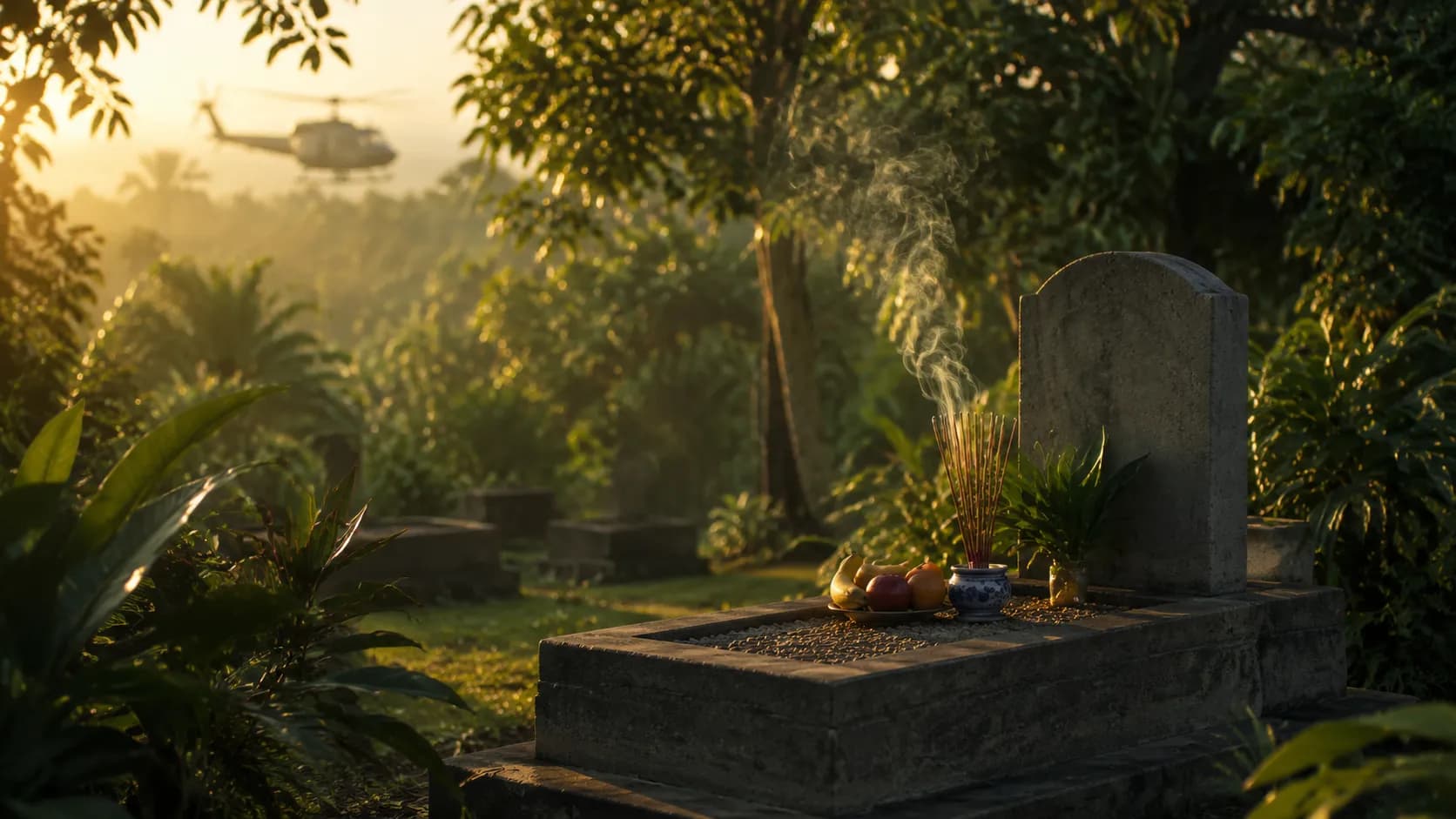
Following the failed excavation, Tria and his son Tuang built a proper grave with a concrete tomb and headstone at the site, making it official. "If Craig's not directly under it, he's very nearby," Huy said. On the anniversary of the day Tria found Farlow's remains — chosen in accordance with Vietnamese tradition, which honours the dead on the day they died rather than at a fixed national holiday — Tria goes to the grave, burns incense, prays, and pulls the weeds.
Farlow is one of 58 military service members from Indiana still listed as unaccounted for by DPAA. Veterans who served alongside him, including fellow pilot Brad Burkholder of Edon, Ohio, have never stopped thinking about him. "I... we... didn't forget," Burkholder said. "If there's any chance his remains can be recovered, somebody needs to put more pressure on it."
The Herald Republican submitted a Freedom of Information Act request to DPAA following the Tours of Duty report. As of publication, DPAA has acknowledged receipt but has released no further information. The Tours of Duty report is available at toursofduty.org.
Stay Ahead of the News
Get the latest business news and company spotlights delivered to your inbox. No spam, unsubscribe any time.
We respect your privacy. Unsubscribe at any time.