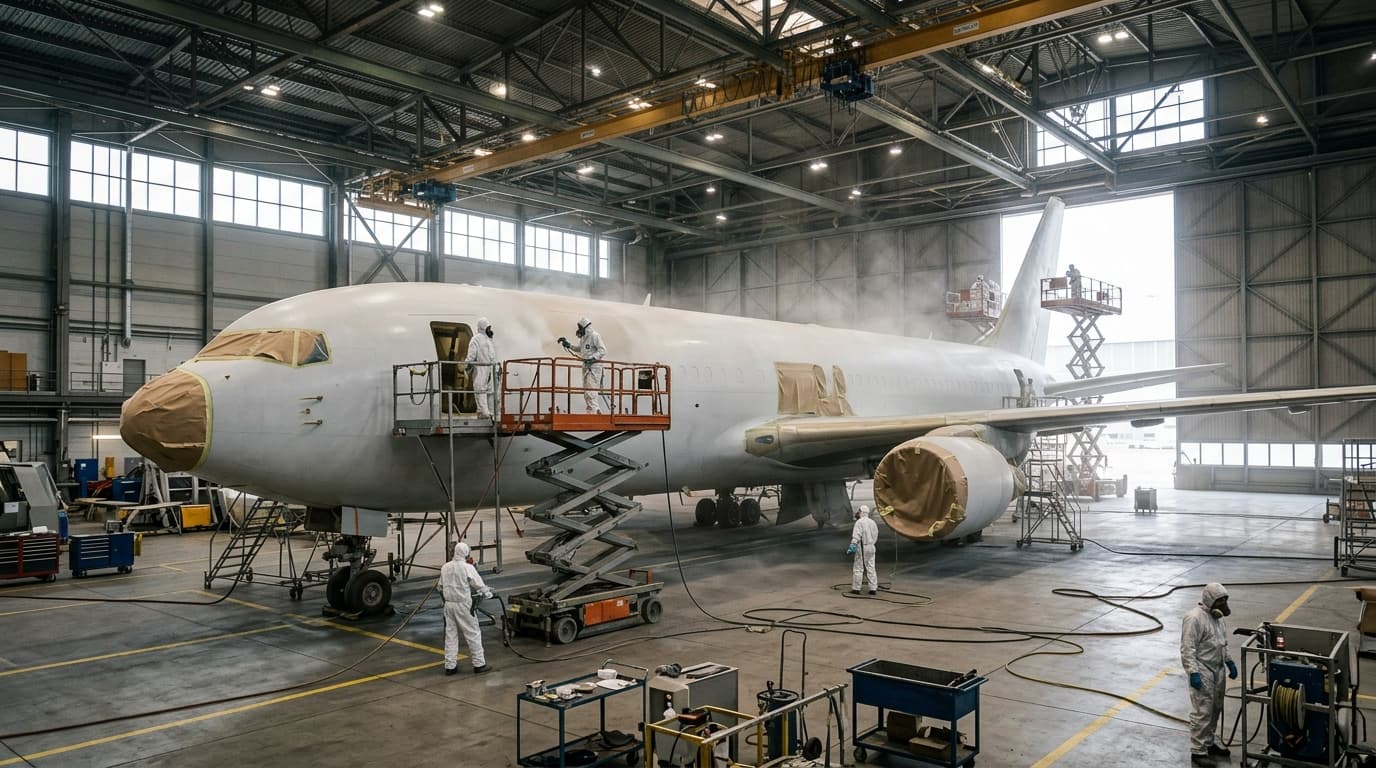
Commercial aerospace coatings market projected to grow from $2.8 billion in 2025 to $4.12 billion by 2030
Fuel-efficiency goals and low-VOC regulations are reshaping which coatings airlines and manufacturers choose
Private equity entry and digital visualization tools point to a maturing, consolidating industry
The market for coatings used on commercial aircraft is on track to expand by nearly $1.1 billion over the next four years, according to new research from The Business Research Company, as airlines and manufacturers face mounting pressure to cut fuel costs and meet tightening environmental standards. The sector is forecast to grow from $2.8 billion in 2025 to $3.03 billion in 2026, before reaching $4.12 billion by 2030 at a compound annual growth rate of 8.0%.
Fuel Efficiency and Emissions Rules Reshape Demand
The growth trajectory reflects a shift in priorities across commercial aviation. Airlines are no longer treating coatings purely as a protective or cosmetic layer; they are increasingly viewing them as part of a broader weight-reduction and aerodynamic strategy that directly affects fuel burn and operating costs.
That shift is converging with regulatory and customer pressure to reduce volatile organic compound emissions during coating application and throughout an aircraft's service life. The research identifies low-VOC and environmentally friendly formulations as one of the defining trends shaping the industry's next phase, alongside advances in corrosion-resistant chemistry and lightweight, fast-curing systems.
Growing passenger traffic and accelerated aircraft replacement cycles are expected to reinforce this demand through 2030. So is an uptick in maintenance, repair and overhaul activity, as fleets age and operators extend aircraft service life rather than retire them outright.
The market's structure, segmented by coating type, resin chemistry, application technology and end use, shows anti-corrosion and functional finishes sitting alongside decorative and thermal barrier coatings, underscoring how varied the performance requirements are across a single aircraft.
Aerospace Coatings Market Set to Hit $4.1B by 2030
Consolidation and Digital Tools Signal a Maturing Industry
Corporate activity in the sector points to consolidation among specialist service providers. In May 2026, private equity firm H.I.G. Capital LLC acquired International Aerospace Coatings, a company focused on aircraft painting, engineering services and asset management for airlines, manufacturers and MRO providers. The deal is intended to expand IAC's hangar capacity and broaden its service offering, a pattern consistent with private equity's wider interest in aviation aftermarket services as fleets grow and maintenance backlogs persist.
Technology is also changing how coatings decisions get made before a drop of paint is applied. The Business Research Company highlights PPG Industries' July 2026 launch of PPG AEROVIEW, a virtual aircraft painter aimed at business and general aviation customers that lets designers and fleet managers preview paint schemes digitally before committing to a physical repaint. Reducing costly repaint errors through simulation mirrors a broader industrial trend of using digital rendering to de-risk capital-intensive decisions, a pattern already visible in sectors from automotive design to construction, where hidden cost drivers in project planning have pushed firms toward similar visualization and estimation tools.
The presence of large diversified chemical and materials companies, including BASF, Dow, PPG, AkzoNobel and DuPont, alongside aerospace-focused specialists like Mankiewicz and Hempel, suggests the market rewards both broad formulation expertise and deep aviation-specific know-how.
Taken together, the acquisition activity, regulatory pressure and digital tooling point to an industry moving beyond simple volume growth toward more specialized, service-oriented offerings. As aircraft fleets expand and environmental requirements tighten further, coatings suppliers that can combine durability, weight savings and emissions compliance are likely to be best positioned through the end of the decade.
Stay Ahead of the News
Get the latest business news and company spotlights delivered to your inbox. No spam, unsubscribe any time.