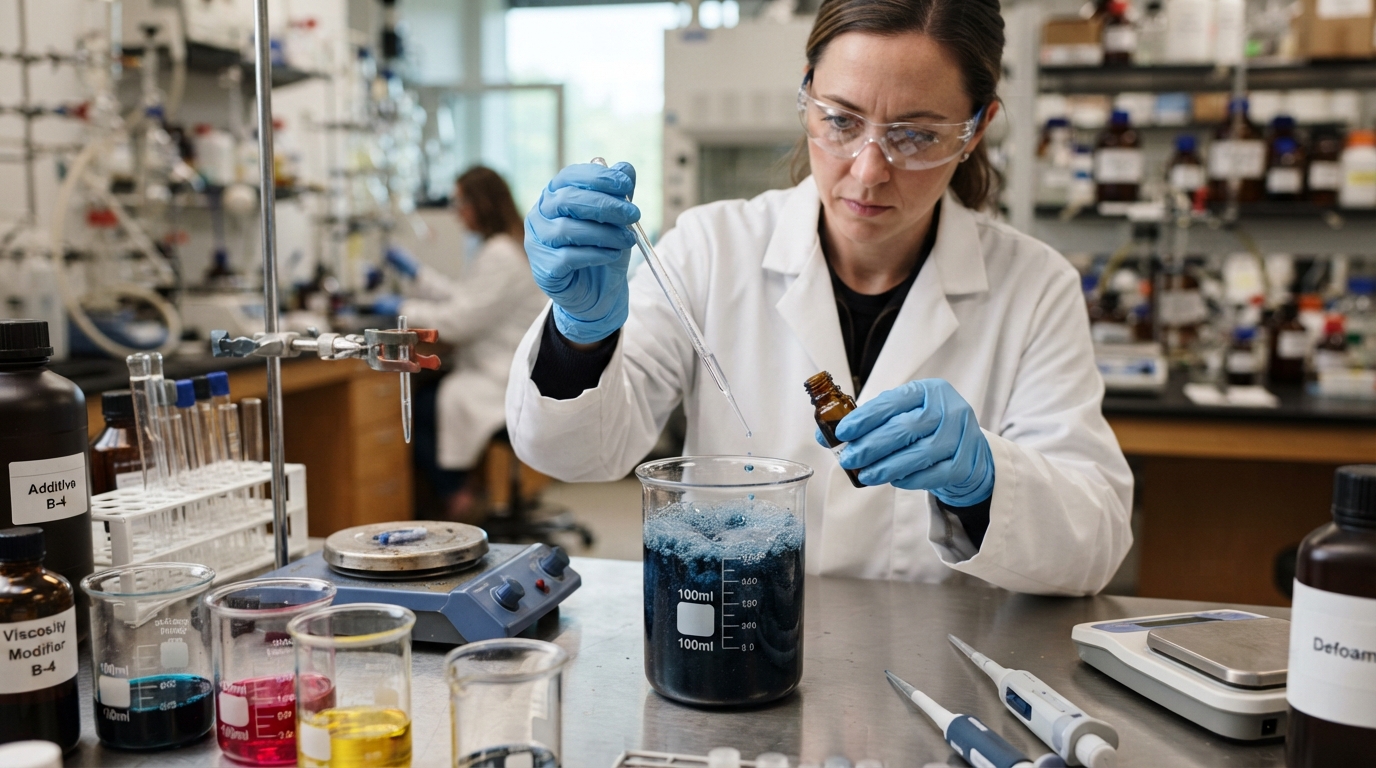
Global ink defoamers market projected to grow from $940.2 million in 2026 to $1,522.3 billion by 2036, a 4.9% CAGR
South Korea leads country-level growth at 6.4%, driven by food-contact rules and packaging printing demand
Packaging applications and ink manufacturers dominate demand as regulatory scrutiny reshapes additive formulation
The global market for ink defoamers, the additives that keep air bubbles from ruining printed packaging and labels, is set to grow from $940.2 million in 2026 to $1,522.3 million by 2036, according to new forecasts from Future Market Insights. The 4.9% compound annual growth rate reflects a quieter but telling shift in industrial chemistry: as printers move away from solvent-based inks toward water-based formulations for environmental and regulatory reasons, they are running into a new technical problem — foam.
Why Foam Has Become a Formulation Headache
Water-based inks rely on surfactants to keep pigments dispersed evenly, but those same surfactants trap air during high-shear press circulation. That trapped air becomes foam, and foam disrupts ink transfer, leaving printers with streaks, pinholes and inconsistent color on finished packaging.
Silicone-based defoamers currently hold the largest share of the market, at 34.0% in 2026, because their low surface tension breaks bubbles quickly and works at low dosage levels. Water-based inks themselves account for 35.0% of demand by ink type, underscoring how the shift toward water-based systems is not just a sustainability story but a direct driver of additive demand.
Flexographic printing, which pumps ink through chambers and anilox rollers, is the largest process-level source of foam-control demand at 31.0% share, since its mechanical circulation constantly reintroduces air into the ink stream. Packaging leads end-use applications with a 36.0% share, a reflection of how costly foam-related defects become when print runs are long and margins are thin.
Regulatory Pressure Fuels Ink Additive Growth
Regulation Is Reshaping Who Buys What, and Where
The country-level data tells a story less about chemistry and more about compliance. South Korea's projected 6.4% CAGR, the fastest among profiled markets, follows a June 2025 update from the country's Ministry of Food and Drug Safety to food-contact standards covering containers and packaging. Mexico follows at 6.1%, tied to packaging recovery programs reported by environmental regulator SEMARNAT, which found member firms collecting an average of 34% of plastic packaging.
Elsewhere, the pattern repeats: Canada's food-packaging safety reviews, U.S. air-quality monitoring updates from the EPA, and Germany's technical guidance on printing-ink substance files are all cited as factors sustaining mid-tier growth of 5.1% to 5.8%. This mirrors a broader trend already visible in adjacent packaging sectors, where policy interventions — from plastic restrictions to material-recovery mandates — are increasingly dictating commercial choices rather than simple cost or performance considerations, a dynamic also evident in how plastic packaging bans have fuelled alternative material booms elsewhere in the supply chain.
France and Japan, by contrast, show the slowest projected growth at 4.8% and 4.4% respectively. Both markets operate under long-established regulatory frameworks — France's tightened mineral-oil limits taking effect in January 2025, and Japan's revised food-contact positive list from June 2025 — that extend product qualification timelines even as they generate demand for well-documented, compliant defoamer grades.
Ink manufacturers, who control formulation, additive testing and resin-compatibility approval, account for 42.0% of the sales channel, reinforcing that defoamer suppliers are selling primarily to formulators rather than end printers. Major suppliers including BYK, Evonik, Dow, BASF, MÜNZING, Elementis, Shin-Etsu Chemical, Wacker Chemie, Ashland and Kemira have been expanding distribution and production capacity accordingly, with BASF starting a new dispersion line in Türkiye in October 2025 and MÜNZING opening a Singapore warehouse in January 2025 to serve Asia-Pacific customers more directly. As food-contact and environmental rules tighten across multiple regions simultaneously, additive suppliers able to document compliance quickly are likely to gain share over those competing purely on price.
Stay Ahead of the News
Get the latest business news and company spotlights delivered to your inbox. No spam, unsubscribe any time.