Click Below To Share & Ask AI to Summarize This Article
Save time and get the key takeaways instantly. Choose your favourite AI assistant to read and analyse this page for you.
At a Glance
- L3Harris delivers critical communication and power systems for Artemis II, the first crewed lunar mission since 1972.
- The company’s S-band transponders and audio control units provide the primary link between the Orion spacecraft and Earth.
- Aerospace sector growth is increasingly driven by deep-space public-private partnerships and long-term lunar exploration goals.
- Advanced radiation hardening and vibration testing ensure mission success during the high-stress phases of launch and lunar flyby.
L3Harris Technologies has officially finalized the delivery of essential hardware for NASA’s Artemis II mission, a milestone that marks the first crewed flight to the lunar vicinity in over five decades. As the successor to the legendary Apollo program, Artemis II serves as a vital test for the Orion spacecraft and its integrated systems before future lunar landings occur. The Florida-based aerospace and defense firm provides the sophisticated communication and power management systems that allow the four-person crew—consisting of Reid Wiseman, Victor Glover, Christina Koch, and Jeremy Hansen—to maintain constant contact with Earth while navigating deep space. This milestone represents a significant achievement for the global aerospace manufacturing sector and underscores the critical role of private industry in the modern space race.
The Artemis II mission is more than just a flight; it is a rigorous stress test of the technologies required to sustain human life beyond low Earth orbit (LEO). Unlike the International Space Station, which orbits approximately 250 miles above the surface, Artemis II will take its crew nearly 250,000 miles away. At these distances, the margin for error is non-existent. L3Harris has spent years refining the hardware that will serve as the "nervous system" of the Orion capsule, ensuring that every command from Mission Control is received and every heartbeat of the astronauts is monitored.
Advanced Communication Architectures and the Deep Space Network
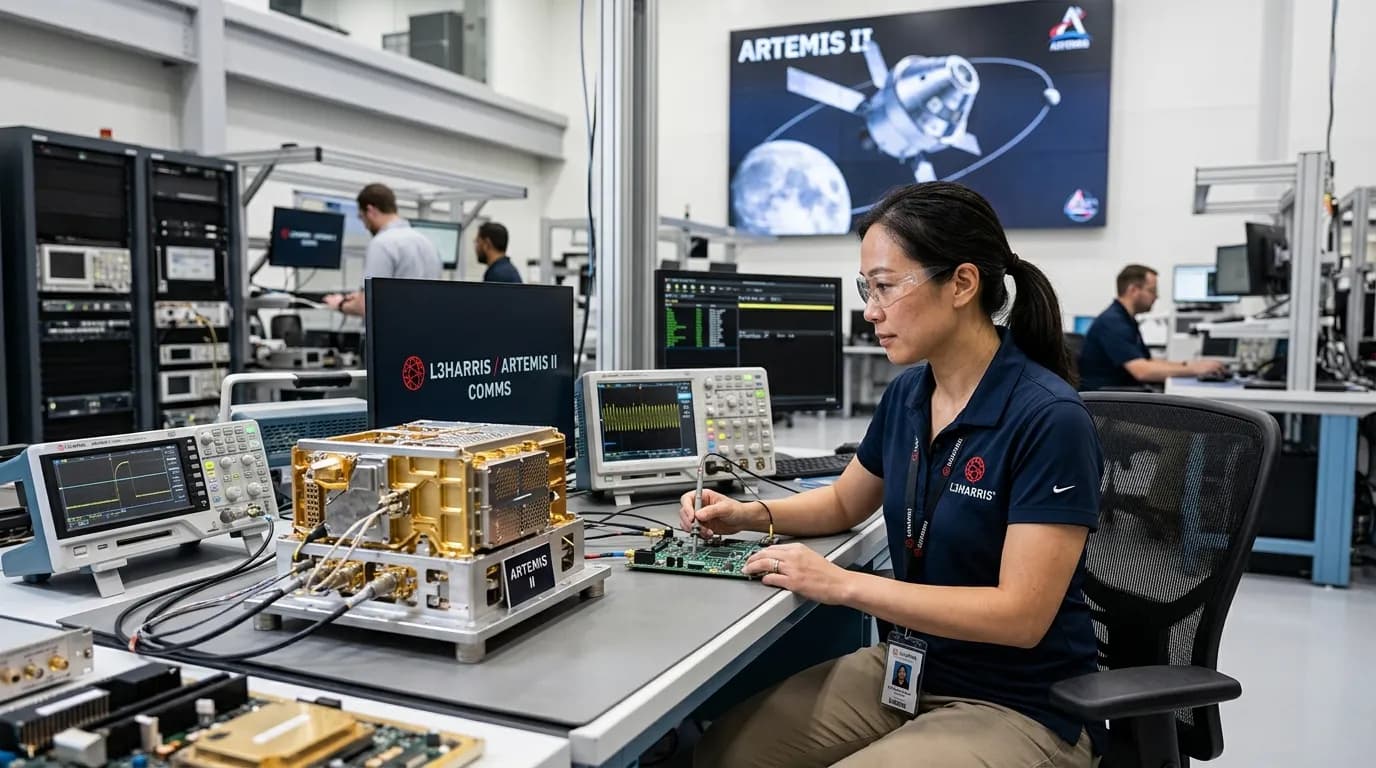
At the heart of the Orion’s mission success are the S-band transponders supplied by L3Harris. These devices facilitate high-speed data transfer between the Orion capsule and the Deep Space Network (DSN), a global array of giant radio antennas managed by NASA’s Jet Propulsion Laboratory. These systems are specifically designed to operate in the harsh radiation environments found beyond the protection of Earth’s magnetic field. By utilizing these transponders, the mission ensures that telemetry, health and status data, and high-definition voice communications remain uninterrupted during the ten-day flight.
L3Harris Technologies has a long and storied history of supporting deep space missions, dating back to the early Apollo era and continuing through the Voyager and Mars Rover programs. The S-band technology used for Artemis II represents the pinnacle of this evolution. These transponders must be capable of locking onto signals across vast distances while moving at thousands of miles per hour. Furthermore, the hardware is built with redundant pathways to ensure that if one component fails due to a cosmic ray strike or hardware fatigue, a secondary system can immediately take over, preserving the link to Houston.
The Audio Control Unit: The Voice of the Crew
The communication suite also includes the Audio Control Unit (ACU), a sophisticated piece of hardware that manages all internal and external voice traffic for the crew. In the cramped and noisy environment of a spacecraft during launch or re-entry, clear communication is a safety requirement, not a luxury. The ACU integrates the astronauts’ headsets with the spacecraft’s radio systems, allowing for seamless transitions between talking to a fellow crew member sitting inches away and speaking to a flight controller on the ground.
This hardware must withstand extreme vibrations during the launch phase of the Space Launch System (SLS) rocket, the most powerful rocket ever built. During the first eight minutes of flight, the Orion capsule is subjected to intense acoustic energy and G-forces. Engineers at L3Harris have conducted thousands of hours of rigorous environmental testing—including thermal vacuum cycles and "shaker table" tests—to verify that these components meet NASA’s stringent human-rating safety requirements. The integration of these systems allows for real-time monitoring of astronaut health and spacecraft performance, providing a psychological and operational lifeline for the crew as they venture into the void.
Power Management and System Reliability
Beyond communications, L3Harris is instrumental in the power distribution architecture of the Orion spacecraft. Reliability is the primary concern for missions that venture hundreds of thousands of miles from the home planet. The power management systems ensure that energy harvested from Orion’s solar arrays is correctly conditioned and distributed to critical life-support systems, navigation computers, and the aforementioned communication arrays. A failure in power distribution could lead to "dark" periods where the crew is unable to maneuver or communicate, a scenario that NASA and L3Harris have worked tirelessly to prevent through the implementation of triple-redundant architectures.
The transponders and power units provide a vital link for the crew to receive instructions and software updates from mission control in Houston. Any failure in this hardware could jeopardize the safety of the astronauts and the future of the Artemis program. As such, L3Harris employs a "zero-defect" manufacturing philosophy for its space-grade hardware. Every solder joint, circuit board, and housing is inspected using advanced imaging technology to ensure it can survive the thermal extremes of space, where temperatures can swing hundreds of degrees depending on whether the spacecraft is in direct sunlight or the shadow of the moon.
The Economic Impact of Public-Private Partnerships
The collaboration between NASA and L3Harris is emblematic of a broader shift in the aerospace industry. The "Artemis Generation" is being built through a robust ecosystem of public-private partnerships that drive innovation and economic growth. By leveraging the expertise of established defense contractors like L3Harris, NASA can focus on mission architecture and scientific discovery while the private sector provides the high-performance hardware needed to reach those goals. This synergy has created thousands of high-tech jobs across Florida’s Space Coast and in engineering hubs across the United States.
As Artemis II paves the way for Artemis III—the mission that will return humans to the lunar surface—the technology provided by L3Harris will continue to evolve. The data gathered during this crewed flyby will be used to refine the next generation of deep-space hardware, including the systems that will eventually support the Lunar Gateway, a planned space station that will orbit the moon. The success of L3Harris in delivering these critical systems on schedule reinforces its position as a leader in the global aerospace market and a cornerstone of America’s return to deep space exploration.
Ultimately, the Artemis II mission is a testament to human ingenuity and the enduring spirit of exploration. With L3Harris’s technology serving as the bridge between the moon and Earth, the four astronauts can focus on their mission objectives, knowing that their connection to home is secured by some of the most advanced engineering in the world. As the Orion spacecraft rounds the far side of the moon, it will be the S-band transponders and audio units that bring the first voices of a new generation back to the people of Earth, signaling a new era of discovery.
Stay Ahead of the News
Get the latest business news and company spotlights delivered to your inbox. No spam, unsubscribe any time.
We respect your privacy. Unsubscribe at any time.