Click Below To Share & Ask AI to Summarize This Article
Save time and get the key takeaways instantly. Choose your favourite AI assistant to read and analyse this page for you.
At a Glance
- CFA certification is a powerful credential but not a guarantee of high-paying finance roles.
- Career outcomes depend on positioning through skills, experience, and professional networking.
- Aswini Bajaj Classes launches an interactive CFA Salary Calculator for candidate benchmarking.
- Structured self-assessment is key to long-term career growth over short-term salary chasing.
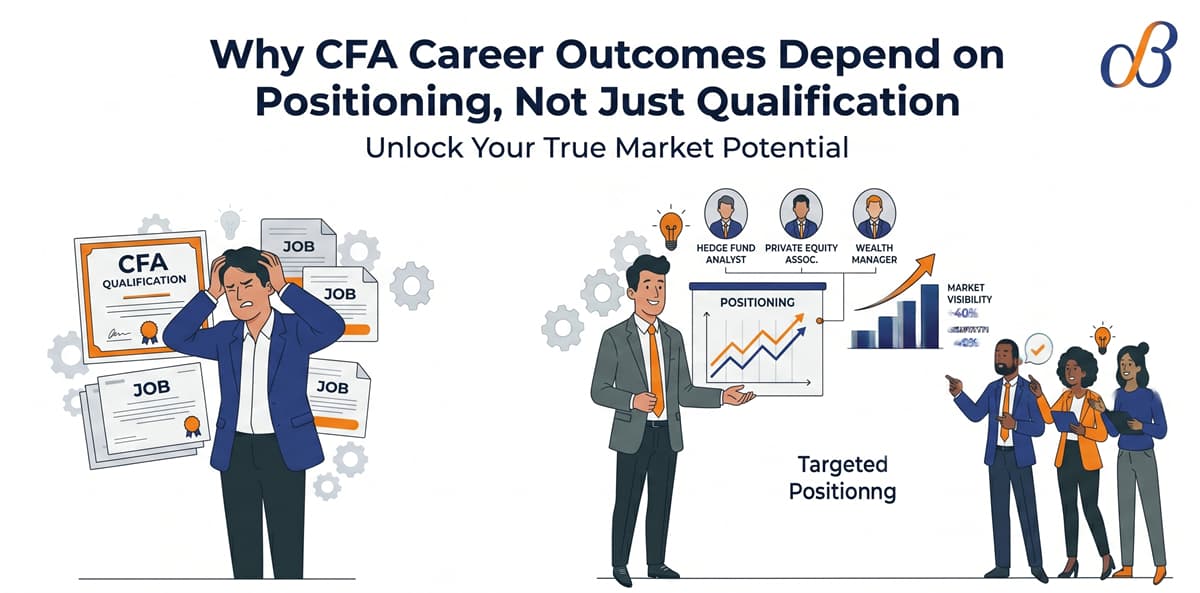
With thousands of candidates enrolling in the Chartered Financial Analyst (CFA) Program each year, a critical question continues to dominate student conversations: is CFA worth it? However, given current industry trends, a more relevant perspective is to ask where the CFA program can position you five years from now. In a rapidly evolving and competitive financial landscape, career success is no longer determined by qualifications alone. Instead, it depends on how individuals position themselves through a combination of skills, experience, judgment, and credibility.
A Strong Credential, Not a Guaranteed Outcome
While the CFA is one of the most globally recognised and respected certifications in finance, it is not a ticket to a high-paying finance job. The program is known for its detailed curriculum and its emphasis on analytical thinking, portfolio management, and financial decision-making. It develops strong financial acumen in candidates, but career outcomes ultimately depend on how effectively those capabilities are applied in the real world.
The program primarily develops strong analytical skills across valuation, portfolio management, and derivatives, along with the ability to make decisions under pressure and uncertainty, and a globally consistent understanding of financial frameworks. While these skills are genuinely valuable, they are not sufficient on their own. Candidates must complement them with communication abilities, practical exposure through internships, and professional networking in order to build a well-rounded and competitive profile.
To help candidates navigate this reality, Aswini Bajaj Classes has introduced an interactive CFA Salary Calculator, which helps candidates benchmark their profiles, understand their market positioning, and make more informed career decisions based on structured data rather than peer comparison.
Expanding Opportunities, Not Defining Careers
Many candidates begin their CFA journey with specific roles already in mind. However, as a leading CFA coaching institution, Aswini Bajaj Classes encourages students to develop their skills in a way that broadens their thinking beyond a single destination in investment banking, equity research, portfolio management, or corporate finance. The teaching methodology is focused on developing both financial and analytical skills that widen the range of opportunities available to each student over time.
Each role in finance demands additional, role-specific capabilities beyond the CFA curriculum. Investment banking requires financial modelling expertise, deal exposure, and strong professional networks. Portfolio management demands independent thinking, capital allocation skills, and risk assessment capabilities. Equity research calls for clear writing, critical thinking, and the ability to form and defend investment views with conviction. Across all of these roles, the CFA serves as a foundational advantage — but not a complete solution in isolation.
Rethinking Salary Expectations
Compensation remains one of the most discussed aspects of pursuing the CFA program, yet students should resist the temptation to choose a career path based primarily on salary expectations. Compensation is not a direct or automatic outcome of any qualification. In reality, salary levels are influenced by depth of skills, chosen role, and overall market positioning — which is why two candidates at the same CFA level can earn significantly different salaries.
Rather than relying on peer comparisons or generalised salary guides, candidates are encouraged to adopt structured benchmarking. This means evaluating their profile against relevant market data, identifying specific skill gaps, and focusing on long-term career growth rather than short-term financial gains. This shift in mindset is central to the approach Aswini Bajaj Classes promotes across its coaching programmes.
"CFA is not a shortcut to success, nor a shortcut to high-paying roles. It is a lever. When used effectively, it sharpens thinking, expands opportunities, and enhances long-term career trajectories. When approached passively, it risks becoming just another credential with limited impact."
— Aswini Bajaj Classes
From Qualification to Positioning
The broader takeaway for every CFA candidate is that the conversation must shift — from asking what salary the CFA will deliver, to asking what position can be built with it and what that position is truly worth. This reframing places the emphasis on long-term strategy and deliberate career development rather than a passive expectation that a certification alone will open doors.
CFA is a lever. When used effectively, it sharpens thinking, expands opportunities, and enhances long-term career trajectories. When approached passively, it risks becoming just another line on a resume with limited real-world impact. The candidates who achieve the strongest outcomes are those who treat the qualification as a starting point for positioning, not a finishing line.
About Aswini Bajaj Classes
Aswini Bajaj Classes offers a mentor-led learning experience for CFA and FRM candidates, along with practical upskilling in Financial Modelling and MS Excel, delivered through both online and offline classrooms in Kolkata. Every session is designed for intensive training, concept clarity, and skill development across core areas including investment management, financial analysis, and ethical standards.
Stay Ahead of the News
Get the latest business news and company spotlights delivered to your inbox. No spam, unsubscribe any time.
We respect your privacy. Unsubscribe at any time.