
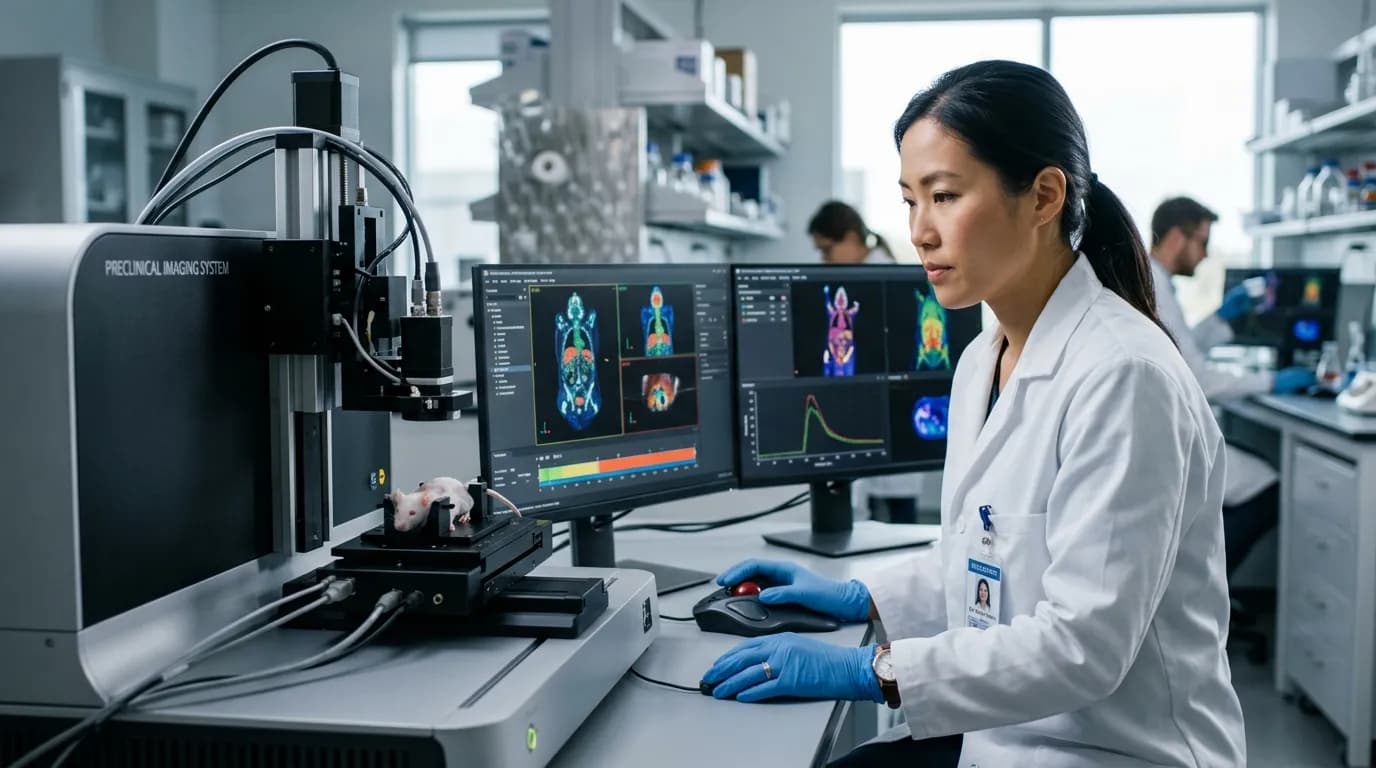
At a Glance
- Market valuation is projected to grow at a 5.5% CAGR through 2032.
- Oncology and cardiology drive the highest demand for imaging systems.
- North America maintains the largest share of the global research market.
The global preclinical tomography system market is poised for significant expansion, with new projections indicating a rise to $1.2 billion by 2032. This growth represents a steady compound annual growth rate of 5.5% from its 2023 valuation of $1.2 billion. Increased investments in pharmaceutical research and the rising prevalence of chronic diseases are the primary factors fueling this upward trajectory. Researchers are increasingly relying on these systems to visualize biological processes in small animal models before moving to human trials.
Technological Advancements and Market Drivers
Modern imaging technologies like Micro-CT, PET, and SPECT are becoming standard in drug development pipelines. These systems allow for non-invasive monitoring of disease progression and therapeutic efficacy over time. The integration of multi-modal imaging capabilities has improved the accuracy of data collected during the early stages of medical research.
Government grants and private funding for life sciences research have reached record levels in several regions. This financial support enables academic institutions and private laboratories to upgrade their existing hardware. Manufacturers are responding by developing more compact and user-friendly systems that require less maintenance than previous generations of equipment.
The shift toward personalized medicine requires a deeper understanding of molecular pathways at the earliest stages of study. Preclinical tomography provides the necessary resolution to observe these interactions in real-time. Consequently, HTF Market Intelligence reports a surge in demand for high-throughput screening tools across the global biotechnology sector.
"The demand for advanced imaging is accelerating as pharmaceutical companies prioritize early-stage accuracy to reduce long-term development costs."
— Nitesh Singh, Lead Analyst at HTF Market Intelligence
Regional Performance and Competitive Analysis
North America currently holds the largest share of the global market due to its advanced healthcare infrastructure and high research spending. The presence of major pharmaceutical giants and top-tier research universities sustains a high volume of imaging projects. Meanwhile, the Asia-Pacific region is expected to witness the fastest growth rate through the end of the decade.
Leading companies like Bruker Corporation and PerkinElmer are focusing on strategic acquisitions to broaden their product portfolios. These organizations are also investing in software that utilizes artificial intelligence to automate image analysis. Such improvements help researchers process large datasets more efficiently than traditional manual methods used in the past.
Oncology remains the largest application segment as cancer research continues to receive the bulk of global health funding. Cardiology and neurology are also showing significant promise, particularly in the study of neurodegenerative conditions. The ability to track physiological changes without sacrificing animal subjects is a major ethical and practical advantage for modern laboratories.
As the industry moves toward 2032, the focus will likely remain on enhancing the sensitivity and speed of tomography systems. Emerging markets in Eastern Europe and Latin America present new opportunities for manufacturers to expand their global footprint. While high initial costs remain a barrier for some smaller labs, the long-term benefits of precise preclinical data are undeniable. The sector is set to remain a cornerstone of medical advancement for the foreseeable future.