Click Below To Share & Ask AI to Summarize This Article
Save time and get the key takeaways instantly. Choose your favourite AI assistant to read and analyse this page for you.
At a Glance
- KBR provides mission-critical engineering and health services for the Artemis II flight.
- The company manages astronaut training and real-time flight control operations in Houston.
- This mission marks the first crewed lunar proximity flight in more than fifty years.
KBR’s Mission Technology Solutions business segment is providing essential technical and operational support for NASA’s Artemis II mission. This mission represents the first crewed flight under the Artemis program, sending four astronauts on a high-stakes flight around the moon. The Houston-based engineering firm manages diverse tasks ranging from flight control to crew health systems. This involvement highlights the company's long-standing partnership with the space agency as international interest in lunar activity intensifies.
Operational Readiness and Crew Safety
KBR specialists are responsible for the physical readiness of the four astronauts selected for the mission. The team oversees the medical systems that track vital signs and radiation exposure during the flight. These protocols are necessary to protect the crew as they travel further from Earth than any humans in recent history.
The company also develops the training curriculum for the Orion spacecraft's pilots and mission specialists. Personnel use high-fidelity simulators to model the physics of lunar gravity and atmospheric reentry. These sessions allow the crew to practice manual overrides and communication protocols under stressful conditions.
In addition to training, the firm provides engineering services for the Ground Systems Development and Operations program. Technicians at the Kennedy Space Center assist with the final assembly and testing of the spacecraft components. This work ensures that the hardware can withstand the extreme vibrations of a heavy-lift launch from the Florida coast.
The contract also includes the management of the crew's nutritional and life support requirements. Specialists calculate the exact oxygen and water supplies needed for the duration of the lunar orbit. This precision prevents resource depletion during the high-stakes flight through deep space.
"Our team remains dedicated to the success of the Artemis program as we assist NASA in returning humans to the vicinity of the moon. This milestone reflects decades of technical expertise and a shared commitment to advancing space flight capabilities."
— Byron Bright, President of KBR Government Solutions U.S.
Mission Control and Data Management
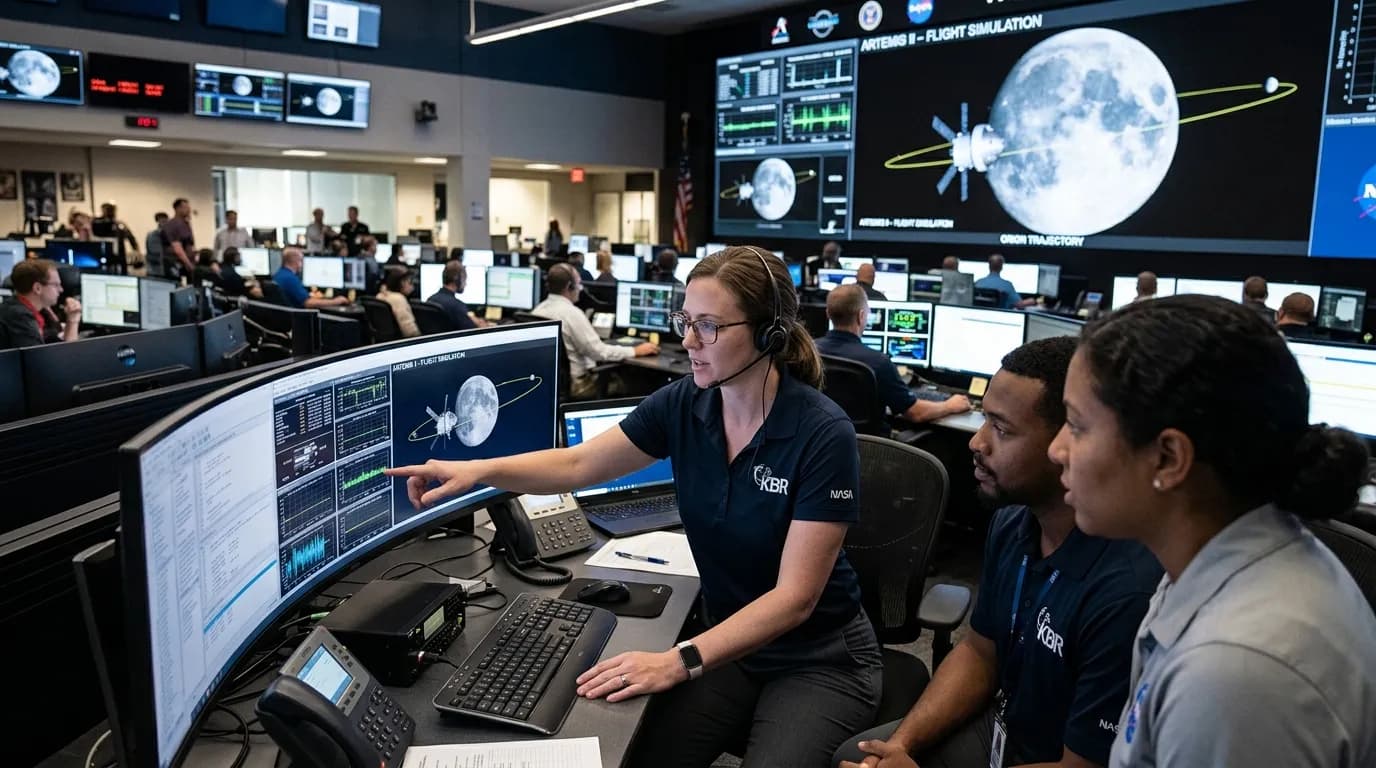
The Mission Technology Solutions division maintains a constant presence within the Christopher C. Kraft Jr. Mission Control Center. Flight controllers employed by KBR monitor the telemetry data sent from the Orion capsule in real time. They track the trajectory of the spacecraft to ensure it remains on the correct path for a safe return to Earth.
Technical teams also coordinate the recovery efforts that will take place in the Pacific Ocean after the mission concludes. Specialists design the flotation systems and retrieval methods used by the U.S. Navy during splashdown. These procedures are vital for the rapid extraction of the crew once the capsule hits the water.
Data analysis constitutes a significant portion of the company's post-launch responsibilities. Engineers process the information gathered by on-board sensors to evaluate the performance of the heat shield and structural components. This assessment helps NASA refine the designs for future missions to the lunar surface and beyond.
The company also manages the software interfaces used by ground teams to communicate with the spacecraft. These systems must operate without interruption to provide the crew with updated flight plans and weather data. Maintaining these communication links is a primary focus for the IT specialists assigned to the project.
The Artemis II mission represents a major step toward establishing a permanent human presence on the moon. KBR’s participation highlights the importance of private sector expertise in achieving national space objectives. As NASA prepares for subsequent landings, the data provided by this mission will serve as a foundation for future lunar architecture. The company intends to remain a primary partner in the development of deep space transportation systems for years to come.
Stay Ahead of the News
Get the latest business news and company spotlights delivered to your inbox. No spam, unsubscribe any time.
We respect your privacy. Unsubscribe at any time.